The Strategic Intent Playbook Part 7
10 min read
WorkSpaceOS — The Intelligent Enterprise Workspace
Bringing People, Enterprise Knowledge, Strategic Intent and AI Together in the Flow of Work
“The future of work is not another application. It is an intelligent environment that understands the employee, the work they are doing and the enterprise around them.”
What You'll Learn
In this playbook, we'll explore how organisations can:
Move beyond a digital workplace built around applications.
Create a personalised workspace built around the employee and their work.
Bring Enterprise Knowledge into the flow of work.
Provide employees with access to the Universal Enterprise Advisor.
Connect everyday decisions with Strategic Intent.
Make enterprise capabilities accessible without employees having to understand the underlying architecture.
Connect collaboration, learning, performance and knowledge.
Create a workspace that becomes progressively more intelligent as the organisation learns.
The Digital Workplace Has Become Fragmented
Over the past two decades, organisations have digitised almost every aspect of work.
Email. Messaging. Documents. Video meetings. CRM. ERP. HR systems. Project management. Learning platforms. Knowledge systems. Analytics. Workflow tools. And increasingly, Artificial Intelligence.
Each technology solves a problem.
Together, however, they have created another one. The employee has become the integration layer.
People spend their working lives moving between applications, searching for information, reconstructing context and determining which system contains what they need.
They search one system for a customer. Another for a document. Another for a colleague. Another for a project. Another for training. Another for performance information. And increasingly, they open a separate AI assistant and provide the context all over again.
The technology environment may be integrated technically. The employee experience often isn't.
From Application-Centric to Employee-Centric Work
Most enterprise software begins with the application. A CRM asks employees to enter the CRM. A learning platform asks them to enter the learning environment. A project system asks them to find the project. A knowledge platform asks them to search for knowledge. The employee adapts to the architecture. WorkSpaceOS reverses that relationship.
It begins with:
Who is the employee?
What are they trying to achieve?
What are they working on?
What do they need to know?
Who do they need to work with?
Which capabilities can help them?
How does their work contribute to Strategic Intent?
The workspace can then bring the relevant knowledge, people, applications and intelligence into the context of that work.
The employee no longer needs to understand where everything resides.
The architecture works for the employee rather than the employee working around the architecture.
WorkSpaceOS Is Not Another Application
This distinction is fundamental.
WorkSpaceOS should not attempt to replace every enterprise application.
Organisations will continue to use specialist systems for finance, customer management, HR, supply chain, engineering, operations and thousands of other purposes.
Those systems remain important.
WorkSpaceOS sits above and across them.
It provides an intelligent operating environment connecting employees with the capabilities distributed throughout the enterprise.
Instead of asking:
“Which application do I need?”
the employee can increasingly ask:
“What am I trying to achieve?”
The workspace determines what knowledge, systems, people and intelligence are relevant.
This changes the organising principle of the digital workplace from applications to intent.
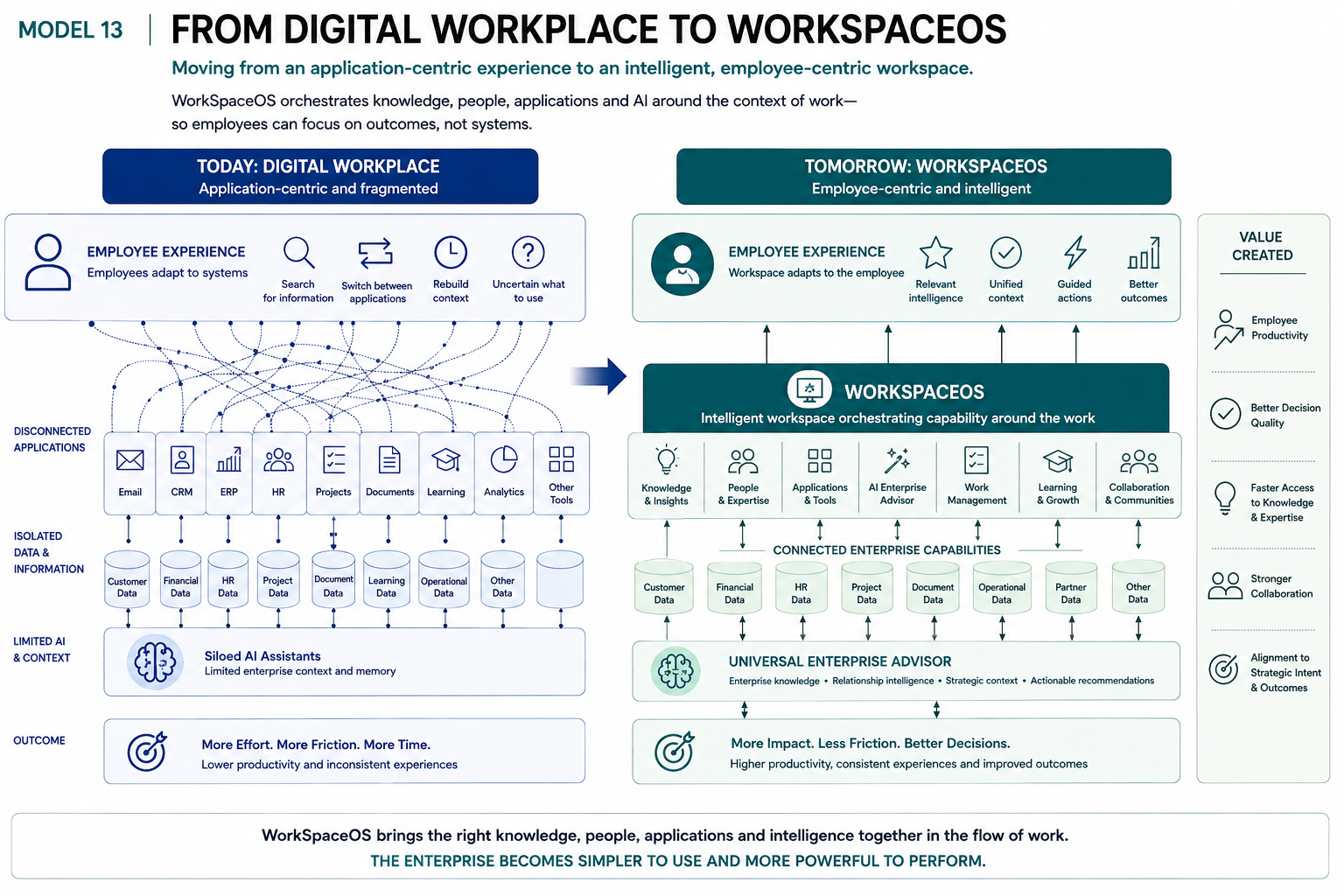
From Digital Workplace to WorkSpaceOS: Illustrates the transition from an application-centric digital workplace, where employees navigate disconnected systems and information, towards an intelligent employee-centric workspace that orchestrates knowledge, people, applications and AI around the work being performed.
The Employee Becomes the Centre of the Architecture
This is where the Enterprise Capability Architecture begins to look different from the employee's perspective. The architecture contains multiple layers. Trusted workforce foundations. Enterprise Knowledge. Connected Strategies. Intelligent Enterprise Value Chains. AI Enterprise Advisors. Industry applications and ecosystems.
Employees should not need to navigate those layers.
They should experience them as capability available through their workspace.
Consider an employee preparing for an important customer meeting. Today, they might open the CRM. Search previous emails. Locate the latest presentation. Review a contract. Find project information. Message colleagues. Search the knowledge system. Look at customer performance. Then ask AI to summarise some of it. In WorkSpaceOS, the employee opens the customer workspace.
The relevant context is already connected. The customer relationship. Previous interactions. Current opportunities. Projects. Commitments. Relevant documents. Internal experts. Strategic priorities. Lessons learned. And the Universal Enterprise Advisor. Instead of assembling context manually, the employee begins with context.
Enterprise Knowledge in the Flow of Work
This is why the Enterprise Knowledge Layer from Part 3 is so important. Knowledge has limited value if employees cannot access it when they need it. Traditional knowledge management frequently asks people to stop working, go somewhere else, search for information and determine whether what they find is relevant. WorkSpaceOS brings knowledge into the work itself. An employee working on a project might automatically discover: a similar project completed three years earlier, the people who delivered it, a decision that affected its outcome, a lesson that should not be repeated, a reusable asset, and an expert elsewhere in the organisation. The employee did not necessarily search for those things. The workspace understood the context well enough to make them relevant. That is the shift from:
Knowledge stored to Knowledge discovered to Knowledge applied.
And when the employee creates new knowledge through their work, that knowledge can flow back into the Enterprise Knowledge Layer. Work and organisational memory become connected.
The Universal Enterprise Advisor Becomes Part of Work
Part 4 introduced the Universal Enterprise Advisor. WorkSpaceOS is where that capability becomes part of everyday work. The employee should not need separate AI experiences for strategy, finance, projects, customers, workforce and knowledge. They interact with one trusted Enterprise Advisor.
Behind it, specialist intelligence can provide the required expertise.
The employee might ask:
“What should I focus on today?”
“What do I need to know before this customer meeting?”
“Who in the organisation has solved this problem before?”
“What are the biggest risks to this project?”
“How does this initiative contribute to our strategic objectives?”
“What should I learn next to prepare for my future role?”
“Which partner capabilities could help us respond to this opportunity?”
These questions cross traditional application boundaries. That is precisely the point. The employee thinks in outcomes. Enterprise technology is organised into systems.
WorkSpaceOS becomes the intelligent layer between them.
From Search to Context
One of the biggest changes may therefore be surprisingly simple. Employees search less. Today, digital work relies heavily on search. Find the document. Find the email. Find the expert. Find the customer record. Find the project. Find the policy.Find the application.
AI improves search considerably. But the bigger opportunity is to reduce the need to search at all.
If WorkSpaceOS understands:
who you are,
what you are working on,
what you are authorised to access,
what the organisation knows,
and what the organisation is trying to achieve,
then relevant intelligence can increasingly come to you.
The model changes from: Employee → Search → Information
towards: Context → Intelligence → Employee
The workspace becomes context-aware.
Strategic Intent Enters Everyday Work
There is another important connection. Most employees do not struggle because their organisation lacks a strategy. They struggle because strategy is often distant from everyday work. Strategic objectives exist in presentations.
Work happens elsewhere.
WorkSpaceOS can begin connecting the two. An employee working on an initiative could understand:
which strategic objective it supports,
why that objective matters,
which enterprise capability is being developed,
what outcomes are expected,
how performance is progressing,
and which other activities depend upon the work.
Strategy becomes context rather than communication.
This is an important distinction.
Employees do not need more strategy presentations. They need strategic context at the point of decision.
Learning Becomes Part of Work
The same principle applies to workforce development. Traditional learning is often separated from work. An employee performs their job in one environment and enters another system to learn. But the most valuable learning requirement frequently emerges from the work itself.
A new responsibility.
A capability gap.
A customer opportunity.
A project challenge.
A new technology.
A future role.
WorkSpaceOS can connect the learning capability introduced in Part 1 directly to those moments.
The workspace understands the employee's role, competencies, experience and aspirations.
It also understands the work being performed and the capabilities the organisation will require in the future.
Learning can therefore become increasingly contextual:
What capability does this person need next—and what is the best way to develop it?
Workforce development becomes part of enterprise capability development.
Collaboration Becomes Capability Discovery
Collaboration also changes. Today, employees often collaborate with the people they already know. That creates invisible organisational boundaries. The best person to solve a problem may sit in another department, country, company or partner organisation.
The employee simply does not know they exist.
Enterprise Knowledge allows WorkSpaceOS to understand expertise and relationships across the organisation.
Instead of asking: “Who do I know who can help?”
the employee can ask: “Who is best positioned to help?”
That person might be:
a colleague,
an expert in another business unit,
someone within another group company,
a strategic partner,
or eventually an AI Enterprise Advisor.
Collaboration becomes capability discovery.
WorkSpaceOS Extends Beyond the Enterprise
Part 6 demonstrated that value increasingly comes from ecosystems rather than isolated organisations.
WorkSpaceOS therefore cannot ultimately stop at the organisational boundary.
A customer opportunity may require collaboration with a strategic partner.
A supplier may need controlled access to specific information.
Two companies within a corporate group may need to work as though they were one team.
External specialists may participate temporarily in a project.
The workspace can provide the shared context required for that collaboration while maintaining appropriate boundaries.
Not everyone sees everything.
Identity, permissions, trust and governance determine what each participant can access.
The objective is:
The right people, knowledge and capability connected around the right outcome, with the right level of trust.
WorkSpaceOS as the Employee Experience of Enterprise Capability
This is perhaps the simplest way to understand WorkSpaceOS.
The Enterprise Capability Architecture describes what capabilities the intelligent enterprise requires.
WorkSpaceOS describes how those capabilities become accessible to people in the flow of work.
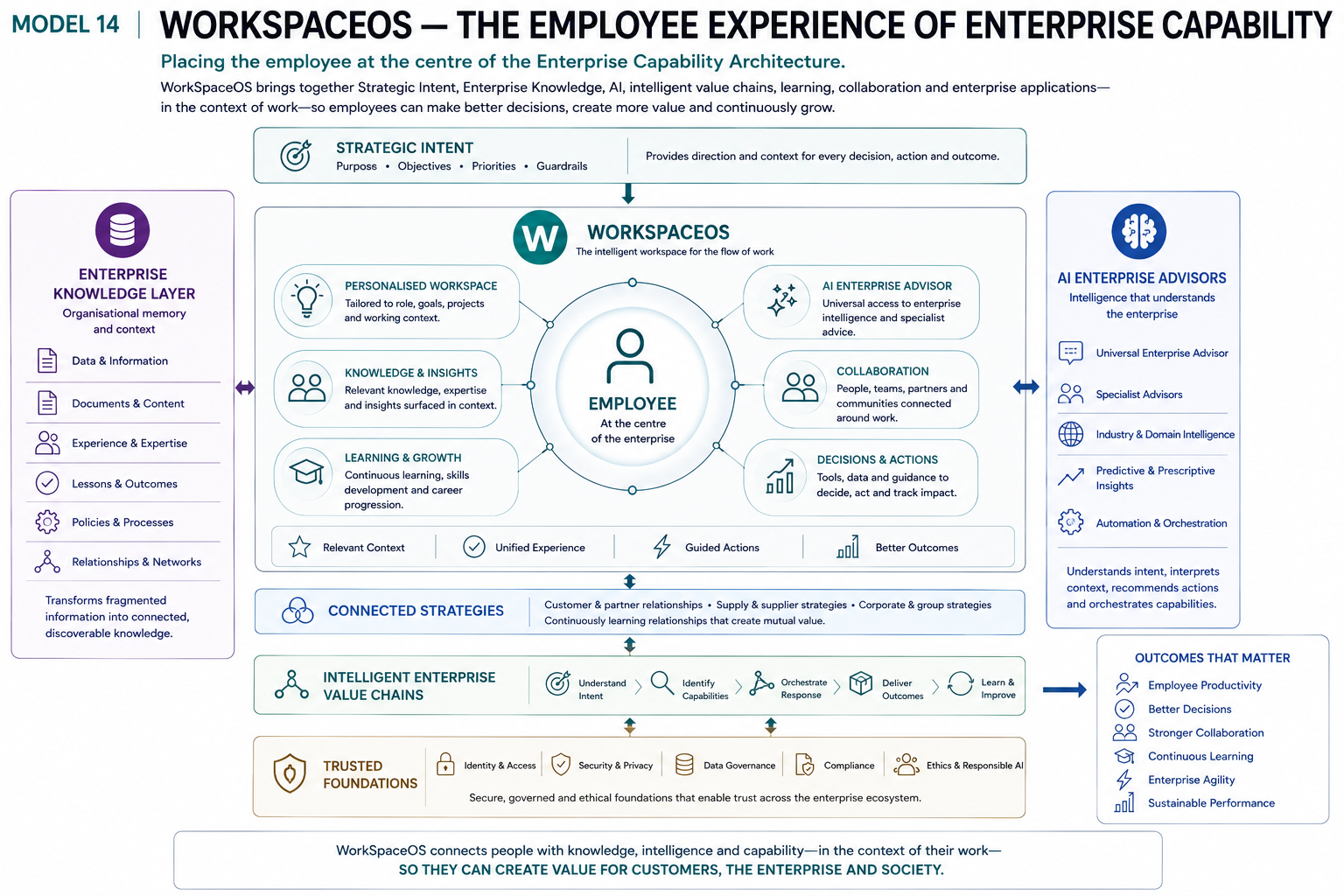
WorkSpaceOS: Illustrates how WorkSpaceOS places the employee at the centre of the Enterprise Capability Architecture, bringing Strategic Intent, Enterprise Knowledge, AI Enterprise Advisors, Intelligent Value Chains, learning, collaboration and enterprise applications together around the context of work.
One Workspace. Many Capabilities.
Underneath WorkSpaceOS may sit hundreds of systems. CRM. ERP. HR. Learning. Finance. Project management. Knowledge. Collaboration. Analytics. Industry applications. AI models. External partner platforms.
The employee should not need to understand that complexity. WorkSpaceOS provides the abstraction layer.
One workspace can expose many capabilities.
One Enterprise Advisor can orchestrate many specialist intelligences.
One Enterprise Knowledge Layer can connect context across many systems.
One identity can determine trusted access.
And one Strategic Intent can provide direction.
The architecture beneath the workspace can remain sophisticated.
The experience above it simple.
Enterprise complexity underneath. Employee simplicity above.
From Productivity to Capability
This distinction matters because much of today's discussion about the future of work focuses on productivity.
How much faster can AI write an email?
How quickly can it summarise a document?
How many meetings can it transcribe?
How much administrative work can it automate?
Those benefits are valuable.
But WorkSpaceOS pursues a larger objective.
Capability.
Can an employee make a better decision?
Can they discover expertise they didn't know existed?
Can they learn from the organisation's previous experience?
Can they understand how their work contributes to strategy?
Can they assemble capabilities across the enterprise around an opportunity?
Can they collaborate effectively with AI?
Can they become more capable over time?
The measure of an intelligent workspace should therefore not simply be:
How much time did we save?
It should increasingly include:
What can our people and our enterprise now do that they could not do before?
The Workspace Learns
The final characteristic of WorkSpaceOS is perhaps the most important. It should not remain static. Every interaction can contribute intelligence. Which knowledge was useful? Which recommendation helped? Which expert solved the problem? Which learning improved performance? Which capability was missing? Which decision created value? Which AI recommendation was rejected? What did the organisation learn?
Those outcomes strengthen Enterprise Knowledge. Enterprise Knowledge improves Enterprise Advisors. Enterprise Advisors improve future work. Future work creates new knowledge.
The workspace therefore participates in the same compounding intelligence loop we have seen throughout the Playbook.
Work → Knowledge → Intelligence → Better Work → New Knowledge
The organisation does not simply become more productive.
It becomes progressively more capable.
Why It Matters
The digital workplace was designed for an era in which enterprise technology was organised around applications.
The intelligent enterprise requires a different model. People should not spend their working lives navigating organisational and technological complexity. Technology should increasingly understand the context of work and bring relevant capability to them.
WorkSpaceOS provides that environment.
It connects people with organisational knowledge.
Knowledge with AI.
AI with decisions.
Decisions with Strategic Intent.
Work with learning.
Opportunities with capability.
And the enterprise with the ecosystems surrounding it.
The result is not another digital workplace.
It is the employee experience of the intelligent enterprise.
The digital workplace gives employees access to applications. WorkSpaceOS gives employees access to enterprise capability.
From Playbook to Intelligent Enterprise
Across seven parts of the Strategic Intent Playbook, we have followed a deliberate progression.
Part 1 — Building a Workforce Ready for the Future
Build and continuously develop the people and capabilities the organisation requires.
Part 2 — From Workforce Capability to Enterprise Capability
Move beyond individual workforce processes towards a connected architecture for enterprise capability.
Part 3 — Building an Enterprise Knowledge Layer
Transform fragmented organisational information and experience into permanent enterprise knowledge.
Part 4 — AI Enterprise Advisors
Use trusted organisational context to augment human judgement and make intelligence accessible.
Part 5 — Intelligent Enterprise Value Chains
Connect capabilities across organisational boundaries around the creation of value.
Part 6 — Intelligent Connected Strategies
Create continuously learning relationships with customers, suppliers, partners and the wider enterprise ecosystem.
Part 7 — WorkSpaceOS
Bring those capabilities together around people and the work they perform.
The destination is not a collection of technologies.
It is an enterprise that is connected, knowledgeable, intelligent and strategically aligned.
An enterprise in which people and AI work together.
Knowledge compounds.
Capability becomes discoverable.
Strategy provides context.
Relationships continuously learn.
And technology increasingly disappears behind the work it enables.
The Intelligent Enterprise
The defining organisations of the AI era may not simply be those that deploy Artificial Intelligence fastest.
They may be those that redesign themselves around what intelligence makes possible.
Organisations that understand their people.
Remember what they learn.
Connect strategy with execution.
Discover capability wherever it exists.
Orchestrate intelligent value chains.
Build continuously learning relationships.
And give every employee access to the collective capability of the enterprise.
That is the ambition behind the Strategic Intent Enterprise Capability Architecture.
And WorkSpaceOS is where that architecture becomes real for the people who use it.
Technology enables. Knowledge informs. AI augments. People decide. Capability creates advantage.
From Playbook to Your Enterprise
The Strategic Intent Playbook describes a destination, but every organisation will take a different path towards it.
Existing technology, workforce capability, organisational knowledge, strategic priorities and transformation maturity will differ.
The question is therefore not whether every organisation should implement the same architecture in the same sequence.
It is:
What should the path towards an intelligent enterprise look like for your organisation?
That is the purpose of the Strategic Intent Blueprint.
Your Strategic Intent Blueprint
The Strategic Intent Blueprint translates the principles explored throughout this Playbook into a practical roadmap for your organisation.
Working with your leadership team, we examine your strategic priorities, existing capabilities, workforce requirements, knowledge environment and technology landscape to identify where greater connection and intelligence could create the greatest value.
The Blueprint then defines the steps required to move from the current environment towards a more intelligent, connected and strategically aligned enterprise.
Rather than beginning with a large-scale transformation programme, the objective is to identify a practical starting point that can demonstrate value while establishing foundations that can be extended over time.
Start with the Workforce Foundation
For many organisations, that starting point is talent acquisition and learning.
Recruitment determines who enters the organisation.
Learning determines how their capability develops.
Connecting the two creates the beginning of a continuous workforce capability system and establishes the foundation upon which wider enterprise capabilities can progressively be built.
The first step can therefore be deliberately focused:
A One-Month Foundational Platform Pilot
The pilot provides an opportunity to explore how a connected Talent Acquisition and Learning platform could work within your organisation.
Over one month, we establish an initial environment around a defined workforce requirement, allowing your organisation to experience the principles of the Strategic Intent architecture in practice.
The objective is not to transform the entire enterprise in 30 days.
It is to prove the foundation, demonstrate the experience and establish a credible path forward.
The pilot can help demonstrate how recruitment and learning can begin operating as one connected capability; how trusted workforce information can be established from the point of entry; how skills, competencies and development can become connected; and how this foundation can progressively support Enterprise Knowledge, AI and the wider Enterprise Capability Architecture.
Start the Conversation
Ready to take the first step?
Discuss your Strategic Intent Blueprint and explore how a one-month Talent Acquisition and Learning pilot could establish the foundation for your organisation's intelligent enterprise journey.
From Strategic Intent to Enterprise Capability
The intelligent enterprise will not be created through a single technology implementation.
It will be built progressively, connecting people, knowledge, intelligence, relationships and technology around Strategic Intent.
The Blueprint defines the path.
The pilot creates the first step.
And each capability built becomes the foundation for the next.