The Strategic Intent Playbook Part 6
10 min read
Building Intelligent Connected Strategies
How Continuous Customer and Partner Relationships, Enterprise Knowledge and AI Can Create Compounding Competitive Advantage
“Competitive advantage increasingly resides not only within the enterprise, but in the intelligence of the relationships surrounding it.”
What You'll Learn
In this playbook, we'll explore how organisations can:
Move from episodic transactions towards continuous customer and partner relationships.
Extend connected strategy principles across suppliers, strategic alliances and corporate groups.
Turn repeated interactions into accumulated relationship intelligence.
Connect customer and partner intent with capabilities across the enterprise ecosystem.
Use Enterprise Knowledge and AI to identify and orchestrate those capabilities.
Reduce friction and cost across connected supply relationships.
Understand how intelligent ecosystems could influence supplier power, switching costs and industry structure.
From Transactions to Continuous Relationships
Most business relationships remain surprisingly transactional.
A customer identifies a need.
A supplier receives an order.
A partner receives a request.
One company within a corporate group asks another for assistance.
An interaction occurs, an outcome is delivered and the relationship waits for the next requirement.
Digital connectivity creates the opportunity to fundamentally change this model.
Wharton professors Nicolaj Siggelkow and Christian Terwiesch developed the concept of Connected Strategy, exploring how connected technologies can transform episodic customer transactions into more continuous relationships.
Their work demonstrates how organisations can reduce friction between the emergence of a customer need and its fulfilment—creating better customer experiences and potentially more efficient delivery models.
Artificial Intelligence creates an opportunity to take this thinking further.
What happens when the connected relationship itself becomes intelligent?
And what happens when continuous connection extends beyond customers to the wider network of suppliers, strategic partners and companies through which enterprise value is created?
This is what we describe as an Intelligent Connected Strategy.
Building on Connected Strategy
The concept of Connected Strategy was developed by Wharton professors Nicolaj Siggelkow and Christian Terwiesch to describe how organisations can use connected technologies to transform episodic customer transactions into more continuous relationships.
The Strategic Intent Intelligent Connected Strategy builds upon this foundation by exploring how Enterprise Knowledge, Artificial Intelligence and Intelligent Enterprise Value Chains could extend continuous connection across a wider ecosystem of enterprise relationships.
The 4R Model
At the heart of a connected relationship is a simple cycle:
Recognise → Request → Respond → Repeat
Recognise: A need or opportunity emerges and is identified.
Request: That need is translated into an actionable requirement with minimal friction.
Respond: The appropriate capability is mobilised to create an outcome.
Repeat: The outcome creates information that improves understanding and informs the next interaction.
The strategic importance of the model lies in Repeat.
Every interaction has the potential to create knowledge.
Knowledge improves understanding.
Better understanding improves the next response.
And better responses strengthen the relationship.
The relationship therefore begins to learn.
From Connection to Intelligence
Consider what happens as the cycle repeats. An interaction generates information. Information creates knowledge. Knowledge improves understanding. Better understanding enables a more relevant response. A better response strengthens the relationship. The stronger relationship generates more interactions. And those interactions generate more knowledge.
The cycle becomes:
Interaction → Knowledge → Understanding → Better Response → Better Outcome → Stronger Relationship → More Interaction
Over time, the relationship begins creating its own intelligence. This is where connectivity can become a source of competitive advantage. A competitor may be able to replicate an application. It cannot instantly replicate years of accumulated relationship knowledge.
The Intelligent Connected Relationship
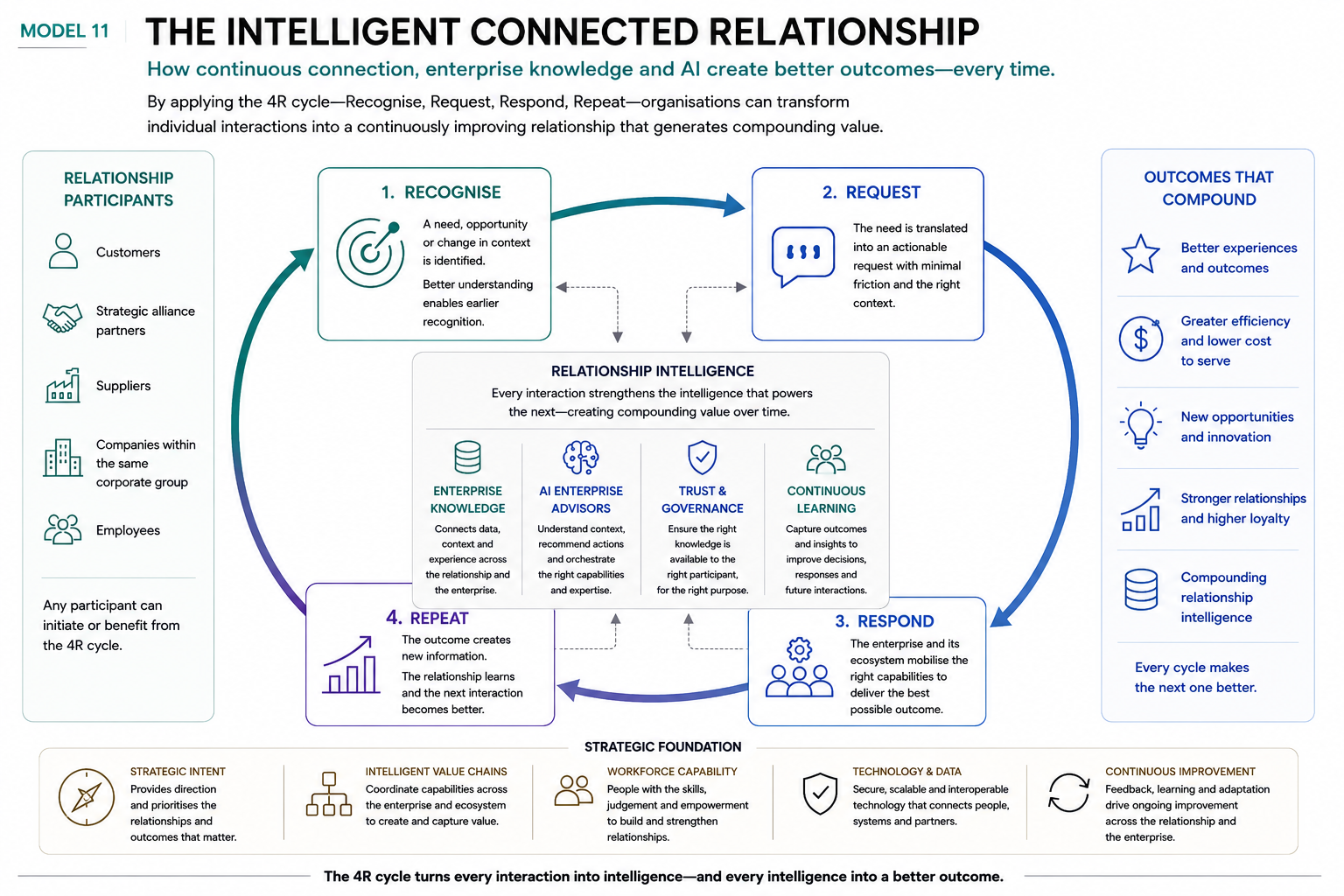
The Intelligent Connected Relationship: Illustrates how the 4R cycle of Recognise, Request, Respond and Repeat combines with Enterprise Knowledge and AI to transform individual interactions into continuously improving relationship intelligence and better outcomes.
From Customer Intelligence to Relationship Intelligence
Connected Strategy was developed primarily around customer relationships.
But organisations create value through a much wider network.
Suppliers. Strategic alliance partners. Technology partners. Distributors. Joint ventures. Companies within the same corporate group.
The same underlying principle can potentially apply.
A supplier can continuously understand changing demand.
Alliance partners can recognise opportunities requiring their combined capabilities.
Companies within a corporate group can identify expertise and resources that already exist elsewhere in the enterprise.
Instead of repeatedly rediscovering each relationship, every interaction can contribute to a growing body of relationship intelligence.
The organisation begins to understand:
Who knows what?
Who can do what?
Which capabilities complement our own?
Which relationships have performed successfully before?
Where does the capability required for this opportunity already exist?
This is where the Enterprise Knowledge Layer becomes critical.
It turns fragmented information about customers, partners, suppliers, expertise and previous outcomes into organisational context that can be discovered and reused.
AI then makes that context navigable at scale.
From Owning Capability to Orchestrating Capability
Imagine a customer presents an opportunity requiring capabilities that do not all exist within the organisation. Specialist expertise may sit within another group company. Technology may come from a strategic alliance. Capacity may exist with a supplier.
Additional capability may come from a technology partner. The traditional enterprise coordinates these participants through separate organisational relationships.
An intelligent connected enterprise can increasingly think differently.
Instead of asking: “What can our organisation do?”
it can ask: “What combination of trusted capabilities can create the best outcome?”
This is an important shift.
The enterprise does not necessarily need to own every capability required to create value. It needs to understand where trusted capability exists and how it can be orchestrated around intent.
Intelligent Enterprise Value Chains Become Critical
This is where the Intelligent Enterprise Value Chains explored in Part 5 become essential.
Connected relationships create opportunity.
The value chain turns that opportunity into an outcome.
Enterprise Knowledge provides context about available capabilities and previous experience.
AI Enterprise Advisors help interpret the requirement and identify relevant capabilities.
Strategic Intent provides direction.
Trust and governance determine what information and capabilities can appropriately be shared.
The value chain orchestrates the response.
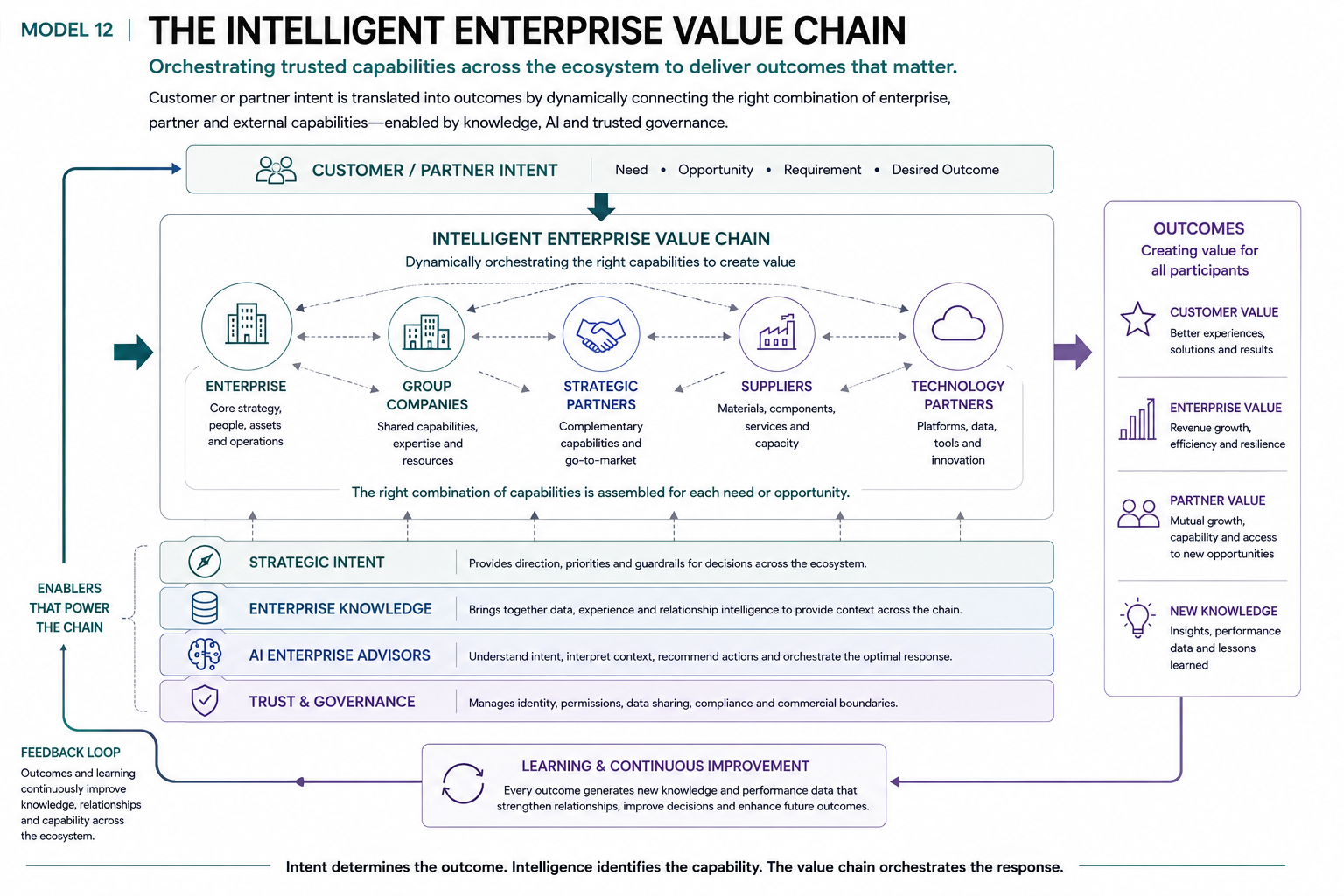
The Intelligent Enterprise Value Chain: Illustrates how customer or partner intent can be translated into outcomes by dynamically orchestrating trusted capabilities across the enterprise, group companies, strategic partners, suppliers and technology partners..
The significance is that the role of the enterprise begins to change.
It moves from simply managing the capabilities it owns towards orchestrating trusted capabilities across a wider ecosystem.
And every outcome generates new knowledge about capability, relationships and performance, making future orchestration more informed.
Intent determines the outcome. Intelligence identifies the capability. The value chain orchestrates the response.
From Connected Supply to Continuous Supply
Supplier relationships provide a powerful example of how this could work. Traditional supply chains operate through repeated transactions.
Demand is forecast. Inventory falls. A requirement is identified. A purchase order is raised. The supplier responds. Goods are shipped. The cycle begins again. Apply the 4R model and the relationship begins to change.
Recognise: Demand, inventory, production schedules or operating conditions indicate a future requirement.
Request: The requirement is communicated with minimal friction.
Respond: Supplier and enterprise coordinate the appropriate response.
Repeat: Actual demand, delivery performance and outcomes improve future planning.
But the more significant change occurs when the relationship moves towards automatic execution. The supplier no longer needs to wait for an individual purchase order.
Within agreed commercial and governance parameters, connected systems could continuously interpret demand, inventory, supplier capacity and logistics, and initiate replenishment automatically.
The relationship moves from: Forecast → Order → Respond → Deliver
towards: Sense → Anticipate → Orchestrate → Replenish → Learn
Supply becomes a continuous connected capability.
Lowering the Cost of Supply
This changes more than speed. A significant proportion of supply-chain cost exists in the friction surrounding the transaction: forecasting, requisitions, approvals, purchase orders, supplier enquiries, reconciliation, expediting, excess inventory, stock-outs and people manually coordinating information between organisations.
Continuous connectivity can reduce some of this friction. More importantly, better information can reduce uncertainty. Traditional supply chains frequently compensate for uncertainty with inventory and time:
More safety stock.
Longer lead times.
Larger orders.
Additional contingency.
Connected demand, inventory and supplier information allows some of those buffers to become more intelligent.
The economic logic is straightforward:
Better information → less uncertainty → lower friction and buffers → lower working capital and supply-chain cost.
Resilience still matters. The objective is not to eliminate buffers or human oversight, but to deploy them more intelligently.
From Automatic Replenishment to Intelligent Supply
There is an even greater opportunity. Automatic execution does not have to mean:
automatically reorder from the same supplier.
Where alternative sources exist, the enterprise could increasingly evaluate a trusted network of qualified suppliers on:
Price.
Quality.
Capacity.
Availability.
Lead time.
Location.
Risk.
Sustainability.
Previous performance.
Strategic importance.
AI could help evaluate these factors against the Strategic Intent and operating context of the enterprise.
The objective becomes:
Automatically orchestrate the best available source of trusted supply.
This moves the organisation from a connected supplier relationship towards an Intelligent Supply Ecosystem.
Could This Change Supplier Power?
Potentially, yes.
In Porter's Five Forces framework, supplier bargaining power is strengthened by factors including limited alternatives, differentiated inputs and high switching costs.
Intelligent connectivity cannot remove genuine scarcity. If only one supplier possesses a critical technology or resource, AI does not create an alternative. But where alternatives exist, a connected supply ecosystem can potentially reduce some of the frictions that reinforce supplier power. It can make alternative capabilities easier to discover. Improve visibility into capacity, price and performance. Reduce the cost of evaluating qualified alternatives. Make genuinely substitutable capabilities easier to identify. And lower some of the operational friction associated with switching.
The buyer becomes less dependent upon knowing a particular supplier and more capable of understanding the supply market.
That can increase buyer optionality and influence the balance of bargaining power.
Connectivity Can Also Create Dependency
There is an important counterargument. Connecting deeply with one supplier can have the opposite effect. Processes become integrated. Data becomes shared. Operational knowledge becomes relationship-specific. Switching becomes harder. Supplier power can increase.
The strategic objective therefore cannot simply be maximum connectivity.
It should be connectivity with optionality. Interoperability, trusted identities, appropriate standards, portable knowledge and modular integration become strategically important because they allow organisations to benefit from connection without unnecessarily locking themselves into individual relationships.
Connectivity without optionality can create dependency. Connectivity with intelligence can create choice.
From Supply Chains to Intelligent Supply Networks
The wider implication is that supply chains can become less linear.
The traditional model: Supplier → Enterprise → Customer
begins evolving towards a network: Customer ↔ Enterprise ↔ Suppliers ↔ Partners ↔ Technology ↔ Group Companies
Information can move through that network faster than physical products. AI can interpret changing demand, capacity and risk. Enterprise Knowledge remembers performance and previous decisions. Intelligent Value Chains coordinate the response.
The network can adapt around changing requirements.
The strategic question therefore changes from: “Who should we buy this from?”
to: “How should our trusted supply ecosystem orchestrate the capabilities required to meet demand?”
This is more than procurement automation. It begins to change the economics and structure of supply.
Competitive Advantage Moves Into the Network
This brings us to the larger strategic implication. Technology is becoming increasingly democratised. Competitors can purchase similar enterprise platforms, access similar cloud infrastructure and increasingly use the same AI models.
What they cannot instantly replicate is the network surrounding an organisation.
Its customer relationships. Supplier relationships. Strategic alliances. Workforce knowledge. Group-company capabilities. Organisational experience. And the accumulated intelligence created through interactions between them.
Competitive advantage can therefore increasingly reside not only inside the enterprise, but within the quality, knowledge and intelligence of its network of relationships.
Technology can be copied. Relationships, knowledge and accumulated intelligence cannot be copied overnight.
Intelligent Connected Strategy
This is the evolution from Connected Strategy towards what we describe as Intelligent Connected Strategy. Connectivity allows relationships to persist. Enterprise Knowledge allows the enterprise to remember. AI helps it understand. Enterprise Advisors make that intelligence accessible. Intelligent Value Chains orchestrate capability. Strategic Intent provides direction. Trusted foundations govern participation.
And every interaction creates new knowledge. Together, these capabilities create a continuously learning system connecting:
Intent → Relationships → Knowledge → Capability → Outcomes → Learning
The organisation becomes progressively better at understanding what is needed, identifying where capability exists and bringing the right capabilities together to respond.
Why It Matters
The enterprise of the future may not be defined simply by the capabilities contained within its organisational boundaries. It may increasingly be defined by the capabilities it can discover, trust, connect and orchestrate. Customers contribute intent and insight. Employees contribute expertise and judgement. Suppliers contribute specialised capability. Strategic alliances create combinations neither organisation possesses independently. Group companies contribute shared knowledge and resources. Technology provides scale. AI provides intelligence. Enterprise Knowledge provides memory and context.
The result is more than a connected organisation.
It is an intelligent enterprise ecosystem capable of learning and creating value across organisational boundaries.
The intelligent enterprise does not need to own every capability. It needs to know where trusted capability exists and how to orchestrate it around intent.
Looking Ahead
Across the Strategic Intent Playbook, we have progressively connected the foundations of the intelligent enterprise.
People.
Knowledge.
AI.
Value chains.
Strategy.
Relationships.
The next challenge is bringing those capabilities together in the environment where people actually work.
Employees should not need to navigate this complexity themselves.
The architecture should work for them.
That is the role of WorkSpaceOS.
Next in the Strategic Intent Playbook
Part 7 | WorkSpaceOS - The Intelligent Enterprise Workspace
Discover how WorkSpaceOS brings people, Enterprise Knowledge, Strategic Intent, Intelligent Value Chains, connected enterprise ecosystems and AI Enterprise Advisors together into a unified working environment—moving beyond a digital workplace built around applications towards an intelligent workspace built around people, knowledge and intent.
Key Takeaways
Connected Strategy demonstrates how connectivity can move customer relationships from episodic transactions towards continuous interaction.
Strategic Intent extends that thinking to customer, supplier, alliance and group-company relationships.
The 4R cycle, Recognise, Request, Respond, Repeat, creates a mechanism through which relationships can continuously learn.
Enterprise Knowledge transforms repeated interactions into relationship intelligence.
Intelligent Enterprise Value Chains allow trusted capabilities to be orchestrated across organisational boundaries.
Connected supply can reduce transactional friction, uncertainty and some supply-chain costs.
Intelligent supply ecosystems may reduce switching friction and influence supplier bargaining power where credible alternatives exist.
Connectivity must preserve optionality; otherwise deeper integration can increase dependency.
Competitive advantage can increasingly emerge from the knowledge and intelligence of the network surrounding the enterprise.
Intelligent Connected Strategy connects intent, relationships, knowledge, capability and learning into a continuously improving system.