The Strategic Intent Playbook Part 5: Building Intelligent Enterprise Value Chains
10 min read
Connecting Strategy, People, Knowledge and AI Across the Enterprise to Continuously Improve How Value Is Created
"Competitive advantage is rarely created by a single function. It emerges from how intelligently the enterprise connects everything required to create value."
What You'll Learn
In this playbook, you'll discover how forward-thinking organizations can:
Move beyond optimizing individual functions to improving end-to-end enterprise value.
Connect customers, employees, suppliers, partners, processes and technology around shared outcomes.
Use Enterprise Knowledge and AI to create more intelligent value chains.
Identify opportunities, constraints and risks across organizational boundaries.
Connect strategic intent with operational execution.
Build value chains that continuously learn, adapt and improve.
The Enterprise Is More Connected Than Its Operating Model
Most organisations are structured around functions.
Sales, Marketing, Operations, Finance, Technology, Human Resources, Procurement, Customer Service.
These structures provide accountability, expertise and control. But customers rarely experience an organization through a single function.
A customer requirement might begin in sales, influence product development, require procurement, flow through operations, involve logistics, generate financial transactions and ultimately depend upon customer service.
Value moves horizontally across the enterprise. Management structures tend to operate vertically.
That distinction matters. Because organisations can optimise every individual function and still deliver a poor end-to-end outcome.
A sales team can exceed its targets while operations struggles to fulfil demand. Procurement can reduce unit costs while introducing supply-chain risk. Technology can deliver a project successfully while the expected business outcome remains unrealised.
Each function may be performing according to its own measures. The enterprise may still be underperforming.
The challenge is therefore no longer simply to optimise functions. It is to connect them around value.
From Functions to Value Chains
A value chain represents the connected activities, capabilities and relationships required to deliver an outcome.
That outcome might be: Acquiring a customer, Launching a product, Delivering a service, Entering a new market, Developing a new capability, Responding to a customer problem.. Creating an entirely new business model, Each requires multiple parts of the organization to work together. Traditional transformation programmes often improve individual components of these chains.
An Intelligent Enterprise Value Chain takes a different approach.
It treats the entire flow of value as a connected system.
The Intelligent Enterprise Value Chain
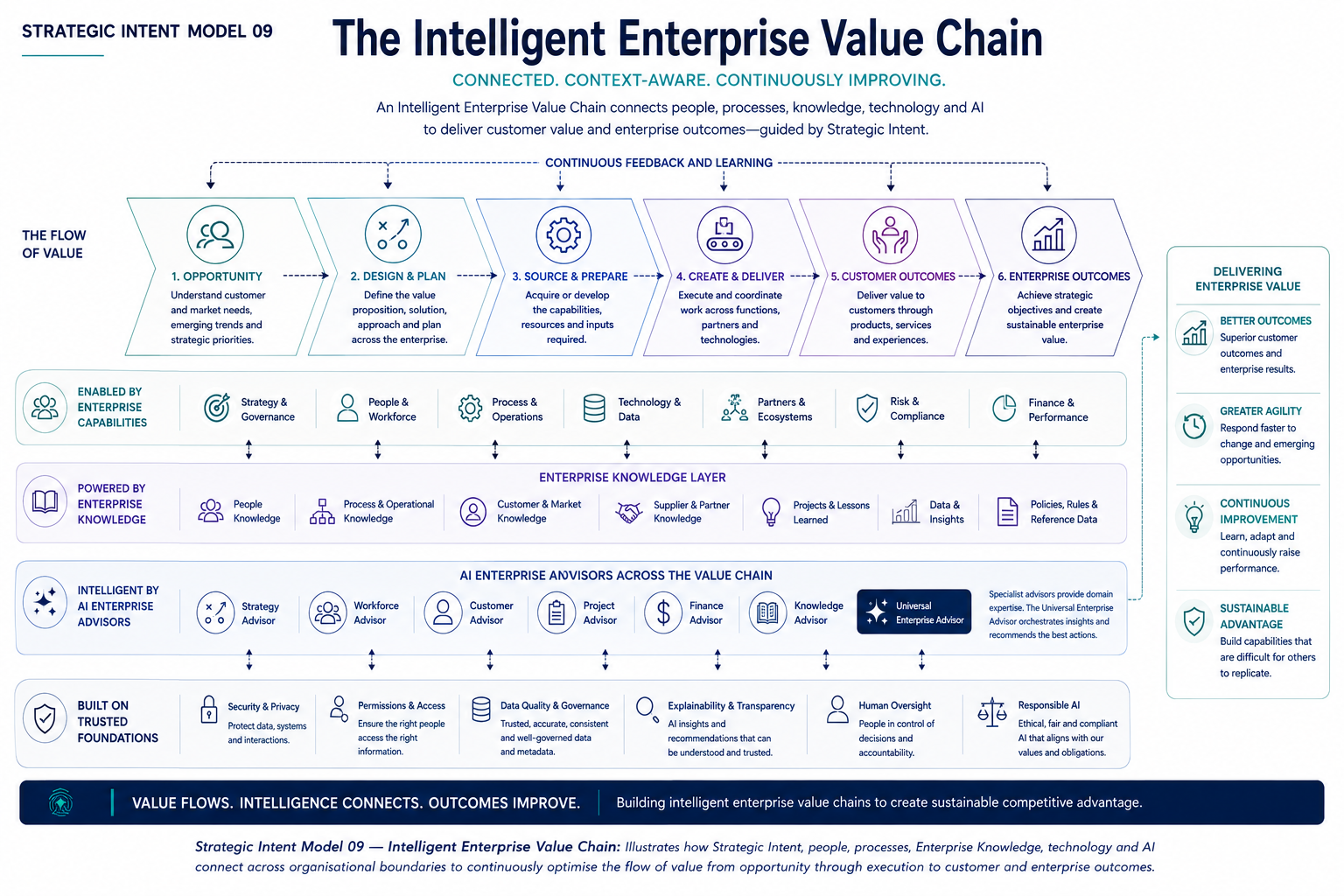
Intelligent Enterprise Value Chain: Illustrates how Strategic Intent, people, processes, Enterprise Knowledge, technology and AI connect across organisational boundaries to continuously optimise the flow of value from opportunity through execution to customer and enterprise outcomes.
What Makes a Value Chain Intelligent?
Connecting processes does not automatically create intelligence. An Intelligent Enterprise Value Chain has several characteristics.
It understands strategic intent, why the value chain exists and which outcomes matter.
It understands context, customers, markets, suppliers, resources, risks and current operating conditions.
It connects knowledge, drawing upon organisational experience rather than repeatedly solving the same problems.
It connects people, bringing the right expertise into decisions regardless of organisational boundaries.
It uses AI to identify patterns, surface opportunities and augment decision-making.
And importantly, it learns. Every outcome produces information. Every decision creates knowledge. Every success reveals something worth repeating. Every failure provides something worth understanding. That intelligence feeds back into the value chain.
The organisation becomes progressively better at creating value.
From Process Automation to Intelligent Orchestration
For decades, organisations have automated processes. Automation remains important. But automation and intelligence are not the same thing.
Automation asks: "How can we execute this process faster?"
Intelligent orchestration asks: "What is the best way to achieve this outcome?"
That distinction becomes increasingly important in complex organisations.
Consider a customer order. Traditional automation might efficiently move that order through a predefined workflow. An intelligent value chain could understand: the importance of the customer, inventory availability, supplier constraints, production capacity, contractual commitments, profitability, delivery risk, previous customer interactions, and the organisation's strategic priorities.
The objective is no longer simply to process the transaction. It is to determine the best enterprise response. That requires intelligence across the value chain.
Enterprise Knowledge Becomes the Connective Tissue
This is where the Enterprise Knowledge Layer introduced in Part 3 becomes critical. Every part of a value chain generates knowledge. Customer conversations reveal needs. Projects generate lessons. Suppliers provide intelligence. Employees develop expertise. Processes generate performance data. Decisions create organisational context. Historically, much of this intelligence remains within the system or department where it originated. The Enterprise Knowledge Layer connects it. A customer opportunity can therefore benefit from previous project experience. A procurement decision can consider customer commitments. A project team can discover expertise elsewhere in the organisation.
An Enterprise Advisor can understand the history surrounding a decision rather than simply analysing the latest data. Knowledge begins moving with value.
AI Enterprise Advisors Across the Value Chain
The Enterprise Advisors introduced in Part 4 provide another important capability. Imagine an organisation responding to a significant new customer opportunity.
A Customer Advisor understands the relationship and opportunity.
A Strategy Advisor evaluates alignment with strategic priorities.
A Finance Advisor assesses commercial implications.
A Workforce Advisor identifies required skills and capacity.
A Project Advisor evaluates delivery complexity and previous lessons.
A Knowledge Advisor identifies relevant expertise and organisational experience.
Through the Universal Enterprise Advisor, these specialist intelligences can work together.
The organisation no longer evaluates the opportunity through a sequence of disconnected departmental decisions. It develops a connected enterprise perspective. This is where AI begins moving beyond personal productivity. It starts helping the organisation operate as an intelligent system.
Connecting Strategic Intent to Value Creation
There is another critical dimension. Value chains should not optimise themselves independently of strategy. Efficiency is not always the objective. An organisation pursuing market expansion may prioritise speed and customer acquisition. Another focused on profitability may prioritise margin and operational efficiency. Another pursuing differentiation may prioritise innovation and customer experience.
The same operational decision can therefore be correct for one organisation and wrong for another.
Intelligent Value Chains need to understand Strategic Intent. Strategic objectives provide direction. Value chains translate that direction into execution. Performance provides feedback. Knowledge captures what the organisation learns. AI helps continuously interpret and improve the system.
This creates a direct connection between strategy and execution.
The Strategy-to-Value Intelligence Loop
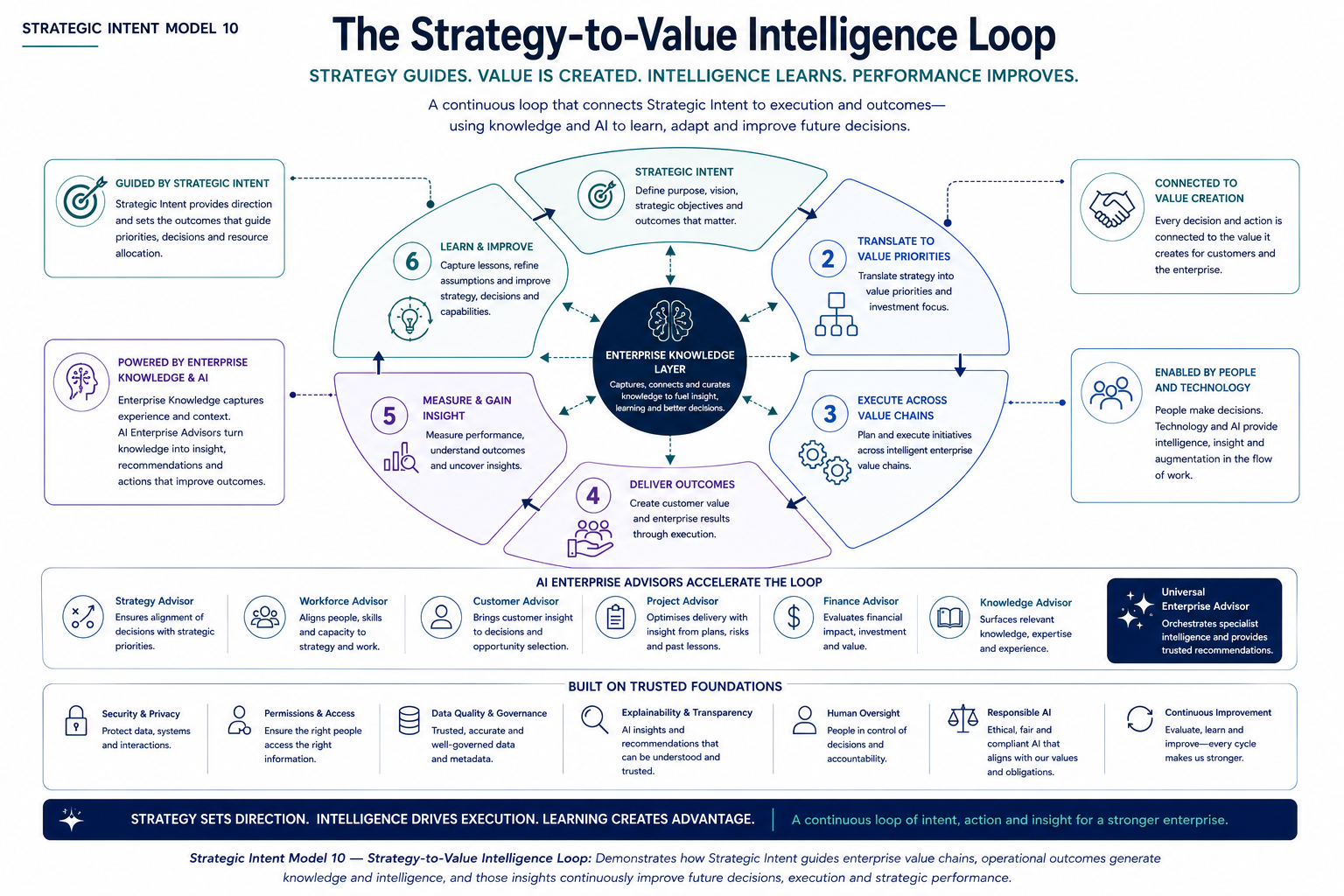
Strategy-to-Value Intelligence Loop: Demonstrates how Strategic Intent guides enterprise value chains, operational outcomes generate knowledge and intelligence, and those insights continuously improve future decisions, execution and strategic performance
Beyond the Boundaries of the Enterprise
Modern organisations rarely create value alone. Suppliers provide capabilities. Partners extend reach. Technology providers enable operations. Distributors connect markets. Customers increasingly participate in product and service development. Value chains therefore extend beyond organisational boundaries. This creates enormous opportunity, but also complexity.
A disruption within one supplier can affect customers thousands of miles away. A change in customer demand can affect production, workforce requirements, inventory and logistics.
A new technology can fundamentally change how an entire ecosystem operates. An intelligent enterprise needs visibility beyond itself. Over time, Enterprise Knowledge and AI can help organisations understand relationships across these ecosystems, identify emerging risks and coordinate decisions across increasingly complex networks.
The value chain evolves into an intelligent value ecosystem.
From Optimising Departments to Optimising Enterprise Outcomes
This represents an important shift in management thinking. Traditional performance management asks: How well is each function performing? Enterprise capability asks: How effectively are we creating the outcomes our strategy requires?
Those are not necessarily the same thing. The most important opportunities often exist between organisational structures rather than within them. Between sales and delivery.Between strategy and execution. Between customers and product development. Between procurement and operations. Between people and technology. Between knowledge and decision-making.
Intelligent Enterprise Value Chains make those connections visible. More importantly, they make them improvable.
The Compounding Effect
The real advantage emerges over time. A traditional process executes. An intelligent value chain learns. Every interaction creates data. Every outcome creates insight. Every insight strengthens enterprise knowledge. Enterprise knowledge improves AI. AI improves decisions. Better decisions improve outcomes. Those outcomes create new knowledge. The cycle repeats.
This is how enterprise capability begins to compound.
And it is why the future competitive advantage of AI may not come from the sophistication of an individual model. It may come from the intelligence of the enterprise system surrounding it.
Why It Matters
Organisations have spent decades optimising departments, implementing applications and automating individual processes. Those investments remain important. But the next stage of enterprise transformation is about connecting them.
When strategy, people, knowledge, technology and AI operate across end-to-end value chains, organisations gain something much more powerful than operational efficiency. They gain the ability to continuously understand and improve how value is created.
Customer outcomes improve. Decisions become better informed. Resources can be deployed more intelligently. Risks become visible earlier. Innovation moves faster across organisational boundaries. And enterprise capability strengthens with every cycle. The objective is no longer simply to create a more efficient organisation. It is to create an organisation that becomes progressively more intelligent at creating value.
Looking Ahead
Intelligent Value Chains create the connection between enterprise intelligence and enterprise execution. But one question remains.
How does an organisation ensure that hundreds or thousands of decisions, initiatives, investments and activities remain aligned with what the organisation is ultimately trying to achieve?
That requires strategy itself to become connected.
Next in the Strategic Intent Playbook
Part 6 | Building a Connected Strategy
Discover how organisations can connect strategic intent with portfolios, initiatives, investment, performance and everyday execution—creating a living strategy that continuously guides enterprise decision-making.
Key Takeaways
Value is created across the enterprise, not within individual organisational functions.
Optimising individual departments does not necessarily optimise enterprise outcomes.
Intelligent Enterprise Value Chains connect people, processes, knowledge, technology and AI around shared outcomes.
Enterprise Knowledge provides the context required for intelligence to move across organisational boundaries.
AI Enterprise Advisors can bring specialist intelligence together to support cross-functional decisions.
Strategic Intent ensures that value chains optimise for the outcomes that matter most to the organisation.
Intelligent value chains continuously learn from outcomes, allowing enterprise capability to compound over time.
The next evolution is to connect this intelligence directly to strategy and enterprise execution.