The Strategic Intent Playbook Part 4 AI Enterprise Advisors
Reading Time: 10 Minutes
"The real opportunity for Artificial Intelligence is not to replace human judgement. It is to give every employee access to the knowledge, context and intelligence they need to make better decisions."
What You'll Learn
In this playbook, you'll discover how forward-thinking organisations can:
Move beyond generic AI assistants towards trusted Enterprise Advisors.
Combine Artificial Intelligence with organisational knowledge and strategic context.
Give employees intelligent support within the flow of work.
Augment human judgement rather than simply automate tasks.
Build specialist AI advisors that understand different business functions and responsibilities.
Establish the foundations for a workforce where people and AI work together through WorkSpaceOS.
From Enterprise Knowledge to Enterprise Intelligence
In Part 3 of the Strategic Intent Playbook, we explored why organisational knowledge is becoming one of the most valuable strategic assets of the modern enterprise.
But capturing knowledge is only the beginning. The greater opportunity is making that knowledge available to people at precisely the moment they need it.
Imagine an employee preparing for an important customer meeting. Instead of searching through emails, CRM records, previous presentations, contracts and meeting notes, they ask an Enterprise Advisor:
"What should I know before meeting this customer?"
The advisor understands the customer relationship.
It understands previous conversations. It knows current opportunities. It understands contractual commitments.
It can identify unresolved issues. And, critically, it understands the organisation's strategic objectives for that customer.
This is fundamentally different from asking a public AI model a question. The AI is no longer simply intelligent.
It is organisationally intelligent!
The Limitations of Generic AI
Generative AI has demonstrated an extraordinary ability to create, summarise, analyse and reason across information. But intelligence without context has limitations. A generic AI assistant may understand finance. It does not necessarily understand your financial strategy.
It may understand sales. It does not understand your customers and relationships.
It may understand project management. It does not know why your transformation programme exists, what has already been attempted or what decisions have previously been made.
It may understand your industry. It does not automatically understand your organisation.
This distinction will become increasingly important as organisations move from experimenting with AI to embedding it within everyday work.
The next generation of enterprise AI must understand not only the question being asked, but the organisational context in which that question exists.
That is the role of the AI Enterprise Advisor.
AI Enterprise Advisors
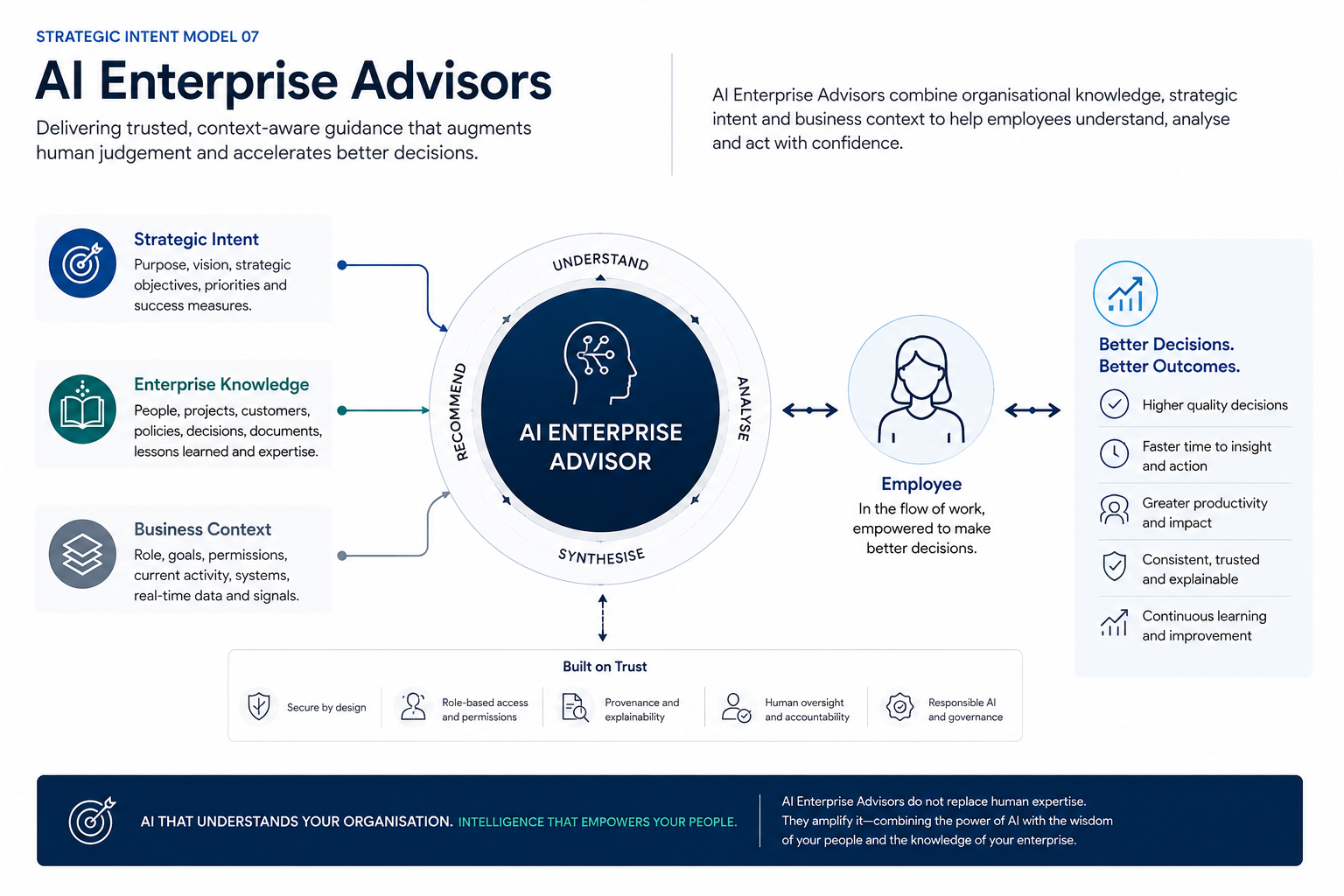
AI Enterprise Advisors: Illustrates how Strategic Intent, Enterprise Knowledge and Business Context combine to provide employees with trusted, context-aware AI guidance that augments human judgement and enables better decisions and outcomes.
The Strategic Intent AI Enterprise Advisor Model demonstrates how Artificial Intelligence can combine enterprise knowledge, strategic intent, business context and specialist expertise to provide employees with trusted, context-aware guidance.
Rather than operating as a standalone chatbot, an Enterprise Advisor becomes part of the organisation's capability, drawing upon trusted knowledge, understanding the employee's role and objectives, and helping people analyse information, evaluate options and take better-informed action.
The objective is not to remove people from decision-making. It is to make every person more capable.
From AI Assistants to Enterprise Advisors
Much of today's enterprise AI conversation centres on assistants and copilots. These tools can deliver substantial productivity improvements. They can summarise documents. Draft emails. Analyse spreadsheets. Generate presentations. Find information. Automate repetitive tasks.
But productivity is only the first stage of the opportunity. An assistant helps someone complete a task.
An Enterprise Advisor helps someone understand what they should do. That distinction is significant.
An Enterprise Advisor understands the context surrounding the work: organisational strategy, policies, relationships, previous decisions, current priorities and the knowledge accumulated across the enterprise. It can therefore move beyond generating content towards supporting judgement.
The question changes from: "Can AI do this task for me?" to: "Can AI help me make a better decision?"
That is a much more valuable enterprise capability.
Giving Every Employee Access to Organisational Intelligence
Historically, access to organisational knowledge has been uneven. Experienced employees know who to ask.Senior leaders understand the history behind decisions. Specialists possess knowledge developed over years of experience. New employees often spend months learning how the organisation really works.
Enterprise Advisors have the potential to change this. By connecting AI to the Enterprise Knowledge Layer described in Part 3, organisations can make institutional knowledge available across the workforce while maintaining appropriate security, permissions and governance.
A new employee could ask: "How have we solved this problem before?"
A project manager could ask "What risks have affected similar programmes?"
A salesperson could ask: "Which capabilities are most relevant to this customer's strategic priorities?"
A leader could ask: "Which initiatives are contributing most strongly to our strategic objectives?"
The underlying knowledge already exists within many organisations. The Enterprise Advisor makes it accessible.
Enterprise Advisors Should Understand Strategic Intent
This is where Strategic Intent becomes particularly important. AI should not simply understand what an organisation knows. It should increasingly understand what the organisation is trying to achieve. Consider two companies facing the same decision. One may prioritise rapid international expansion. Another may prioritise margin improvement. A third may prioritise customer retention. The same information can therefore lead to very different recommendations. Context matters. Strategy matters.
Intent matters.
When strategic objectives become part of the context available to Enterprise Advisors, AI can begin helping employees understand not simply what is possible, but what is most relevant to the organisation's direction. This creates a direct connection between strategy and everyday decision-making.
A Network of Specialist Enterprise Advisors
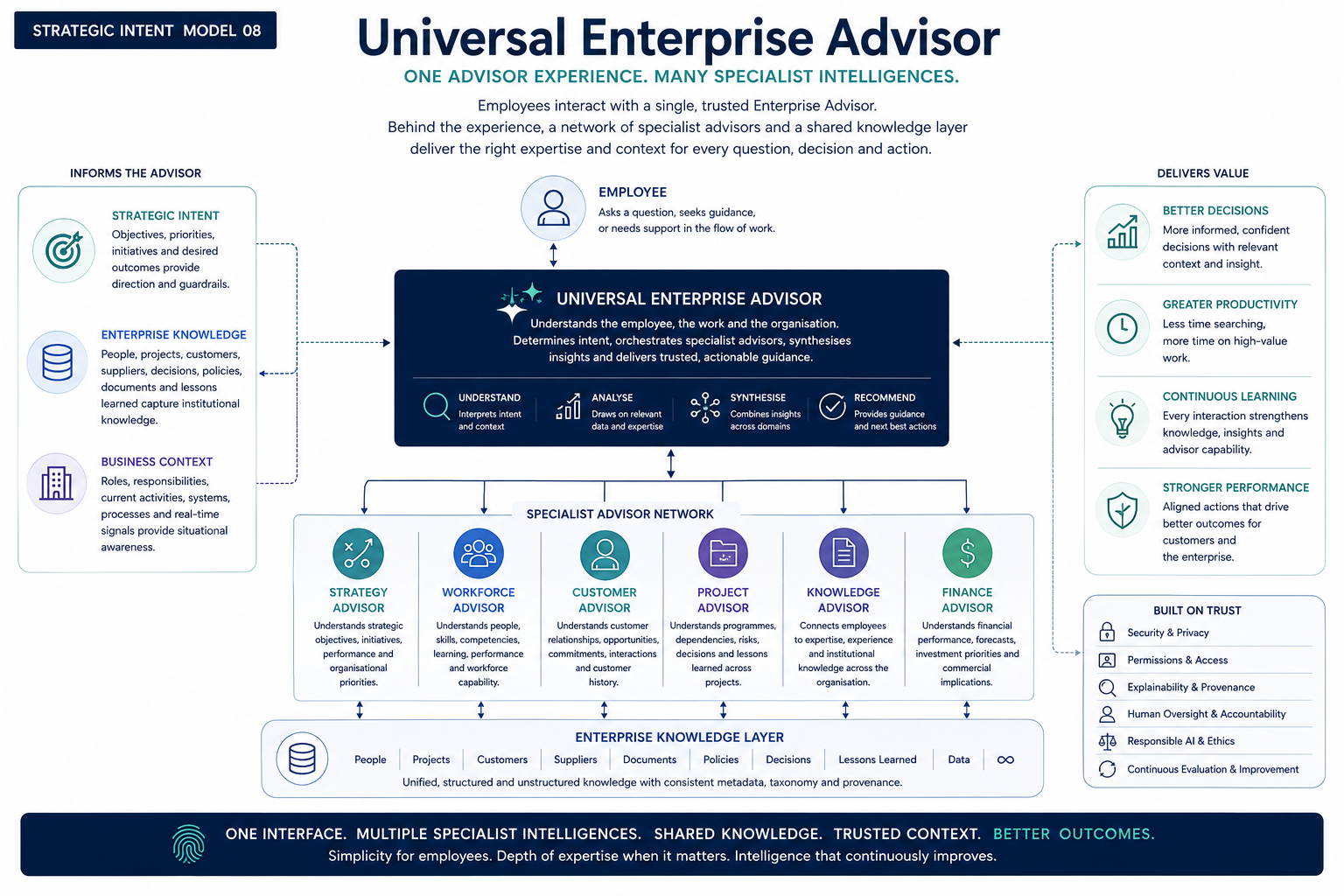
Universal Enterprise Advisor: Illustrates how a single, trusted AI experience orchestrates a network of specialist advisors, drawing on Strategic Intent, Enterprise Knowledge and Business Context to deliver the right expertise at the right moment, enabling better decisions, greater productivity and continuously improving enterprise capability.
One Enterprise Advisor. Many Specialist Intelligence Models.
Artificial Intelligence within the enterprise should not require employees to navigate a growing collection of separate AI assistants.
Instead, the Strategic Intent vision is for employees to interact with a Universal Enterprise Advisor, a trusted, context-aware intelligence layer capable of understanding the employee, their work and the organisation around them.
Behind that experience sits a network of specialist Enterprise Advisors, each providing deep intelligence within a particular domain.
A Strategy Advisor understands strategic objectives, initiatives, performance and organisational priorities.
A Workforce Advisor understands people, competencies, learning, performance and workforce capability.
A Customer Advisor understands relationships, opportunities, commitments, interactions and customer history.
A Project Advisor understands programmes, dependencies, risks, decisions and lessons learned.
A Knowledge Advisor connects employees with organisational expertise, experience and institutional knowledge.
A Finance Advisor understands financial performance, investment priorities, forecasts and commercial implications.
These advisors can operate independently when specialist capability is required, but they also work collectively through the Universal Enterprise Advisor. The employee therefore does not need to understand which AI model, system or knowledge source should answer a question. The Enterprise Advisor determines the relevant expertise, draws upon the appropriate specialist advisors and trusted Enterprise Knowledge Layer, and synthesises that intelligence into a coherent response.
This creates a fundamentally different experience:
One interface. Multiple specialist intelligences. One trusted enterprise context.
Together, they create an increasingly intelligent support system around the organisation.
AI Should Augment Human Capability
The purpose of Enterprise Advisors is not to create an autonomous organisation in which algorithms make every decision.
Organisations are human systems. Judgement matters. Experience matters. Relationships matter. Leadership matters. The greatest opportunity for AI is therefore not simply replacing human activity. It is augmenting human capability. AI can analyse more information than an individual employee. It can identify relationships across thousands of documents. It can recall previous decisions. It can surface relevant expertise. It can model alternatives. It can identify patterns that might otherwise remain invisible. People provide judgement, empathy, creativity, accountability and an understanding of nuance.
The combination is considerably more powerful than either working independently.
Trust Must Be Designed In
As Enterprise Advisors become more influential, trust becomes essential. Employees need to understand where recommendations come from. Organisations need to know which information an advisor can access. Sensitive knowledge must remain appropriately protected. Recommendations should be traceable to trusted organisational information wherever possible. Governance cannot be added after deployment.
It needs to form part of the architecture from the beginning.
This means Enterprise Advisors should operate within clear controls for:
Identity and access.
Data security and privacy.
Knowledge provenance.
Human oversight.
Responsible AI.
Auditability.
Continuous evaluation and improvement.
The more capable AI becomes, the more important these foundations become.
From Individual Productivity to Enterprise Capability
This represents a fundamental change in how organisations should think about the business case for AI. The first wave of generative AI has largely focused on individual productivity. How much faster can someone write an email? How quickly can they summarise a document? How many administrative tasks can be automated? These improvements matter.
But the larger opportunity lies in enterprise capability.
What happens when every employee can access the collective knowledge of the organisation?
What happens when lessons from one project improve the next?
What happens when strategy becomes visible within everyday decisions?
What happens when AI can connect expertise that previously existed in different departments?
And what happens when organisational intelligence continuously improves as people and AI work together?
The value of AI then moves beyond saving minutes.
It begins improving how the enterprise thinks, learns and executes.
The Foundation for WorkSpaceOS
Enterprise Advisors also change the role of the traditional digital workplace. Today, employees typically move between applications to find information and complete work. Email, CRM., ERP, Documents., Project management., Collaboration platforms., Knowledge systems.
Employees effectively become the integration layer between all these technologies.
The future should work differently.
Through WorkSpaceOS, the workspace can increasingly understand the employee, the work being undertaken, the organisational knowledge surrounding it and the strategic outcomes being pursued.
Enterprise Advisors become part of that environment.
Instead of employees continually searching for systems, information and expertise, intelligence comes to them within the context of their work.
This is the transition from a digital workplace built around applications to an intelligent workspace built around people, knowledge and intent.
Why It Matters
Artificial Intelligence is rapidly becoming available to every organisation.
Access to AI alone will therefore not create sustainable competitive advantage.
The differentiator will be the enterprise context surrounding it.
Organisations that connect AI with trusted organisational knowledge, strategic intent and human expertise will be able to create Enterprise Advisors that become increasingly valuable as the organisation learns.
Their AI will understand more.
Their people will have access to better intelligence.
Their decisions will become better informed.
And their organisational capability will compound.
The objective is not an enterprise with fewer people.
It is an enterprise in which every person becomes more capable.
Looking Ahead
Once people and AI can work together through trusted Enterprise Advisors, the next question becomes how that intelligence connects across the activities through which organisations create value.
Customers.
Suppliers.
Partners.
Operations.
Products.
Services.
These relationships form the value chains of the enterprise.
Making those value chains intelligent is the next stage of the journey.
Next in the Strategic Intent Playbook
Part 5 | Building Intelligent Value Chains
Discover how organisations can connect people, partners, customers, suppliers, enterprise knowledge and AI across the activities that create value—transforming fragmented processes into intelligent, adaptive value chains that continuously learn and improve.
Key Takeaways
Generic AI becomes significantly more valuable when it understands organisational context.
The Enterprise Knowledge Layer provides the trusted intelligence foundation for Enterprise Advisors.
Enterprise Advisors should support judgement and decision-making, not simply automate tasks.
Strategic intent provides AI with context about what the organisation is trying to achieve.
Networks of specialist Enterprise Advisors can bring relevant intelligence to different roles and business functions.
Trust, governance and human accountability must be designed into enterprise AI from the beginning.
The long-term opportunity for AI is not simply greater individual productivity, but continuously improving enterprise capability.
WorkSpaceOS provides the future environment through which people, organisational knowledge and Enterprise Advisors can work together.