The Strategic Intent Playbook Part 3 Building an Enterprise Knowledge Layer.
Reading Time: 10 Minutes
"Every organisation possesses more knowledge than it can access. The organisations that win in the age of Artificial Intelligence will be those that transform knowledge into enterprise capability."
Why Organisational Knowledge Has Become the Most Valuable Strategic Asset in the Age of Artificial Intelligence
What You'll Learn
In this playbook, you'll discover how forward-thinking organisations can:
Transform organisational knowledge into a strategic enterprise asset.
Break down information silos and preserve critical business knowledge.
Build an Enterprise Knowledge Layer that connects people, processes and AI.
Enable AI to make context-aware recommendations using trusted organisational intelligence.
Lay the foundation for AI Enterprise Advisors and the intelligent enterprise.
The Hidden Asset Every Organisation Already Owns
Every organisation invests heavily in recruiting talented people, developing workforce capability and implementing technology.
Yet one of its most valuable assets often remains unmanaged. Knowledge.
Every customer interaction. Every project. Every proposal. Every lesson learned. Every process improvement. Every strategic decision. Every successful collaboration.
Together, these represent decades of organisational experience and intellectual capital. Unfortunately, much of this knowledge exists only in documents, emails, meetings, disconnected applications or, most critically, in the minds of individual employees.
When people leave, organisations don't simply lose employees.
They lose context. Experience. Relationships. Decision-making history. Lessons learned. The result is an organisation that repeatedly solves the same problems instead of building upon what it already knows.
Knowledge Is No Longer Documentation
Historically, organisations viewed knowledge management as a documentation exercise. Policies. Procedures. Document repositories. Shared drives. Intranets. While valuable, these approaches capture information. They rarely capture organisational intelligence.
Modern enterprises require something fundamentally different. They require a living knowledge layer that continuously connects people, relationships, projects, decisions, customers, suppliers and strategic objectives. Knowledge should no longer be stored. It should become active.
Enterprise Knowledge Layer
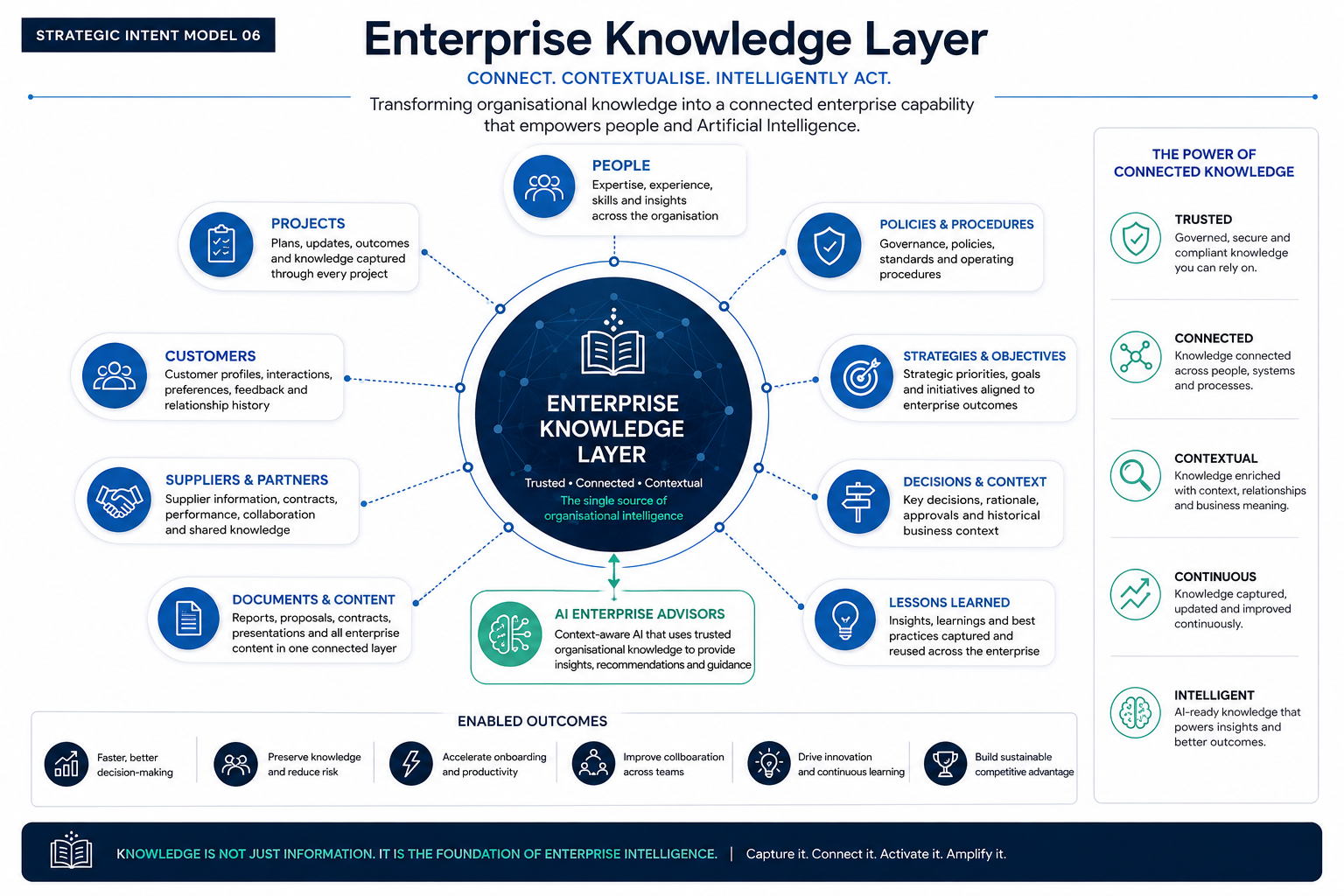
The Strategic Intent Enterprise Knowledge Layer demonstrates how organisations transform fragmented information into a connected enterprise capability. By capturing relationships, decisions, expertise and organisational context in a trusted knowledge layer, every interaction contributes to a permanent enterprise memory that empowers people, accelerates decision-making and provides the intelligence foundation for Artificial Intelligence.
Most organisations store knowledge in documents, emails, shared drives and disconnected business applications. Valuable experience often remains with individuals, making it difficult to share expertise, preserve organisational memory or provide AI with the context required to deliver meaningful business insights.
The Strategic Intent Enterprise Knowledge Layer provides a different approach. It connects people, projects, customers, policies, decisions and lessons learned into a single, continuously evolving knowledge ecosystem. Rather than simply storing information, the Enterprise Knowledge Layer captures organisational context, preserves institutional knowledge and transforms experience into a strategic asset that compounds over time.
As knowledge becomes connected and continuously enriched, organisations make better decisions, accelerate innovation and create a trusted foundation for AI-powered Enterprise Advisors and the future WorkSpaceOS platform.
The Strategic Intent Enterprise Knowledge Layer transforms organisational knowledge from a collection of disconnected documents into a connected enterprise capability.
Rather than storing information in isolated systems, knowledge is continuously captured, connected and enriched with organisational context.
Every project. Every customer interaction. Every decision. Every lesson learned. Every capability.
Together they create an enterprise memory that becomes increasingly valuable over time.
Instead of knowledge leaving with employees, it becomes part of the organisation's permanent capability.
Why Enterprise Knowledge Changes Everything
Knowledge is no longer simply a support function. It is becoming the operating system for organisational intelligence. When knowledge is connected: Employees make better decisions. Projects begin with previous experience instead of starting from scratch.
New employees learn faster. Teams collaborate more effectively. Innovation accelerates because ideas build upon existing knowledge rather than rediscovering it. Knowledge compounds. Capability compounds. Competitive advantage compounds.
The Foundation for Artificial Intelligence
Artificial Intelligence is only as effective as the knowledge available to it. Public AI models understand general knowledge. They do not understand your organisation.
They don't know:
Your customers. Your strategy. Your operating model. Your policies. Your intellectual property. Your culture.
Your decision-making history. Without enterprise knowledge, AI provides generic answers.
With enterprise knowledge, AI becomes a trusted advisor. The Enterprise Knowledge Layer provides the context that allows AI to deliver relevant, accurate and organisation-specific recommendations. Rather than replacing human expertise, AI amplifies it.
From Knowledge Management to Knowledge Intelligence
The future is not another document management system. It is an intelligent knowledge ecosystem.
Information becomes connected. Context becomes searchable. Relationships become visible. Experience becomes reusable. Artificial Intelligence becomes contextual. Organisational capability continuously grows. This is the transition from knowledge management to knowledge intelligence.
Why It Matters
The organisations that outperform their competitors over the next decade will not necessarily possess more data.
They will possess better organisational knowledge.
More importantly, they will know how to connect that knowledge to people, decisions and Artificial Intelligence.
Knowledge becomes the foundation upon which every future enterprise capability is built.
Looking Ahead
Capturing organisational knowledge is only the beginning.
The next evolution is making that knowledge available to every employee exactly when it is needed.
This is where Artificial Intelligence moves beyond automation and becomes an active participant in enterprise decision-making.
Next in the Strategic Intent Playbook
Part 4 | AI Enterprise Advisors
Discover how AI Enterprise Advisors use organisational knowledge, strategic context and real-time business intelligence to augment decision-making, accelerate execution and empower every employee with trusted, context-aware guidance.
Key Takeaways
Organisational knowledge is becoming one of the most valuable strategic assets of the modern enterprise.
Traditional knowledge management captures documents; enterprise knowledge captures context, relationships and organisational intelligence.
Connected knowledge enables faster learning, better collaboration and more informed decision-making.
AI only delivers meaningful business value when it understands the organisation it is supporting.
The Enterprise Knowledge Layer provides the trusted foundation for AI Enterprise Advisors and the future WorkSpaceOS