The Strategic Intent Playbook Part 1
Building a Workforce Ready for the Future
Why Recruitment and Learning Should Be One Intelligent System
Reading Time: 10 Minutes
"The organisations that will lead tomorrow are not those that simply hire the best people, they are those that continuously build workforce capability."
What You'll Learn
In this first playbook, you'll discover how forward-thinking organisations can:
Transform recruitment from a transactional HR process into a strategic capability.
Combine AI, competency-based assessment and workforce intelligence to make better hiring decisions.
Build strategic talent pipelines that support future workforce demand.
Connect recruitment, learning and organisational knowledge into a single operating model.
Establish the foundation for an intelligent enterprise through the Strategic Intent methodology and the future WorkSpaceOS roadmap.
The Workforce Challenge
Every organisation recognises that people are its greatest asset. Yet many continue to manage recruitment, learning, performance and collaboration as isolated activities supported by disconnected technologies.
Recruitment platforms help fill vacancies.
Learning systems deliver training.
Performance platforms measure outcomes.
Collaboration tools enable communication.
Organisational knowledge is often dispersed across documents, emails and disconnected applications.
Each system performs its own function, but very few work together to strengthen workforce capability as a whole.
The result is predictable.
Organisations become increasingly efficient at managing HR processes while becoming less effective at developing the people, knowledge and capabilities needed to execute their strategy.
As artificial intelligence reshapes industries and skills continue to evolve, this fragmented approach is becoming increasingly difficult to sustain.
Leading organisations are beginning to recognise that recruitment is not an isolated HR process.
It is the starting point for building an intelligent, connected workforce capable of delivering long-term strategic success.
Strategic Intent Workforce Capability Operating Model
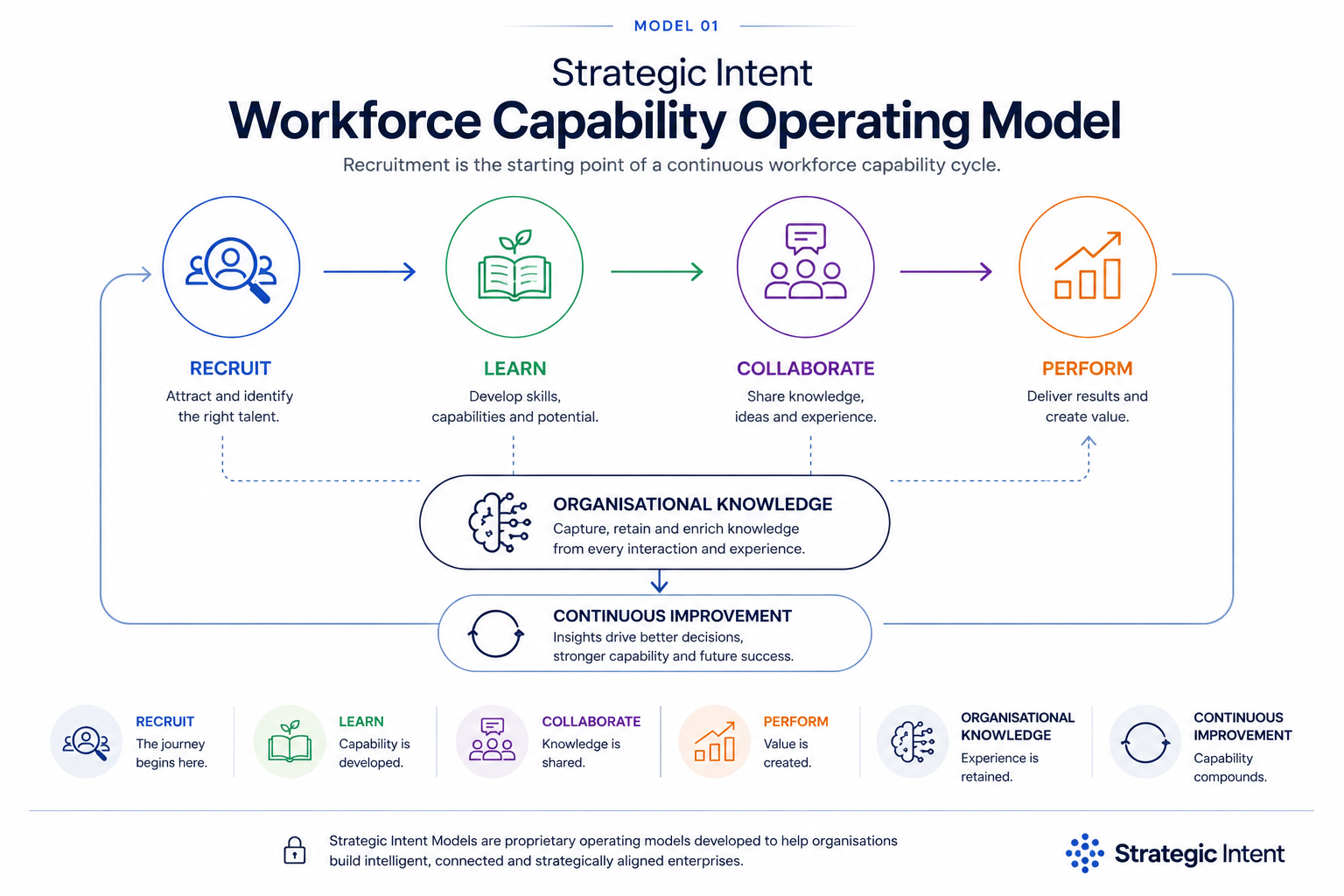
The Strategic Intent Workforce Capability Operating Model positions recruitment as the beginning of a continuous capability-building cycle rather than a standalone hiring process. By integrating recruitment, learning, collaboration, performance, organisational knowledge and continuous improvement into a single operating model, organisations create a workforce that becomes progressively more capable, more connected and better aligned to strategic objectives.
The Strategic Intent Workforce Capability Operating Model demonstrates how organisations can transform recruitment from a transactional HR activity into a continuous capability-building cycle.
Every new employee progresses through learning, collaboration and performance, while organisational knowledge is continuously captured and reinvested into future workforce development.
Rather than optimising isolated HR processes, organisations create a workforce that becomes progressively more capable, more connected and better aligned with strategic objectives.
Recruitment becomes the beginning of capability development—not the end of the hiring process.
Most organisations manage recruitment, learning, collaboration and performance as separate functions, each supported by different technologies with different objectives. The result is fragmented workforce data, duplicated effort and inconsistent capability development.
The Strategic Intent Workforce Capability Operating Model takes a different approach. Recruitment becomes the starting point of a continuous workforce capability lifecycle, where every employee contributes to organisational knowledge, every learning experience strengthens capability, and every collaboration improves future decision-making.
Rather than simply filling vacancies, organisations continuously build the skills, knowledge and capabilities needed to execute their strategic intent.
Recruitment Should Build Capability, Not Just Fill Vacancies
For decades, recruitment technology has focused on one objective:
Fill vacant positions as quickly as possible.
While reducing time-to-hire remains important, speed alone does not create organisational advantage.
The more important question is not: Who can perform this role today?
It is: Who will help us build the organisation we want to become?
Every recruitment decision influences future leadership, organisational culture, innovation, customer experience and long-term business performance.
Recruitment should therefore be viewed not as an HR transaction, but as the first stage of enterprise capability development.
Looking Beyond the CV
Traditional recruitment relies heavily on CVs, job descriptions and interviews.
These remain valuable, but they rarely tell the complete story.
Experience demonstrates what someone has done.
Competencies reveal how they achieve results.
Learning agility indicates how quickly they can adapt.
Collaboration determines how effectively they contribute across teams.
Strategic alignment indicates how their strengths support the organisation's long-term direction.
Modern recruitment requires organisations to evaluate all of these dimensions simultaneously.
Artificial intelligence enables this by analysing multiple sources of workforce intelligence, providing hiring managers with richer insights while supporting more consistent, evidence-based recruitment decisions.
Strategic Intent Talent Intelligence Model
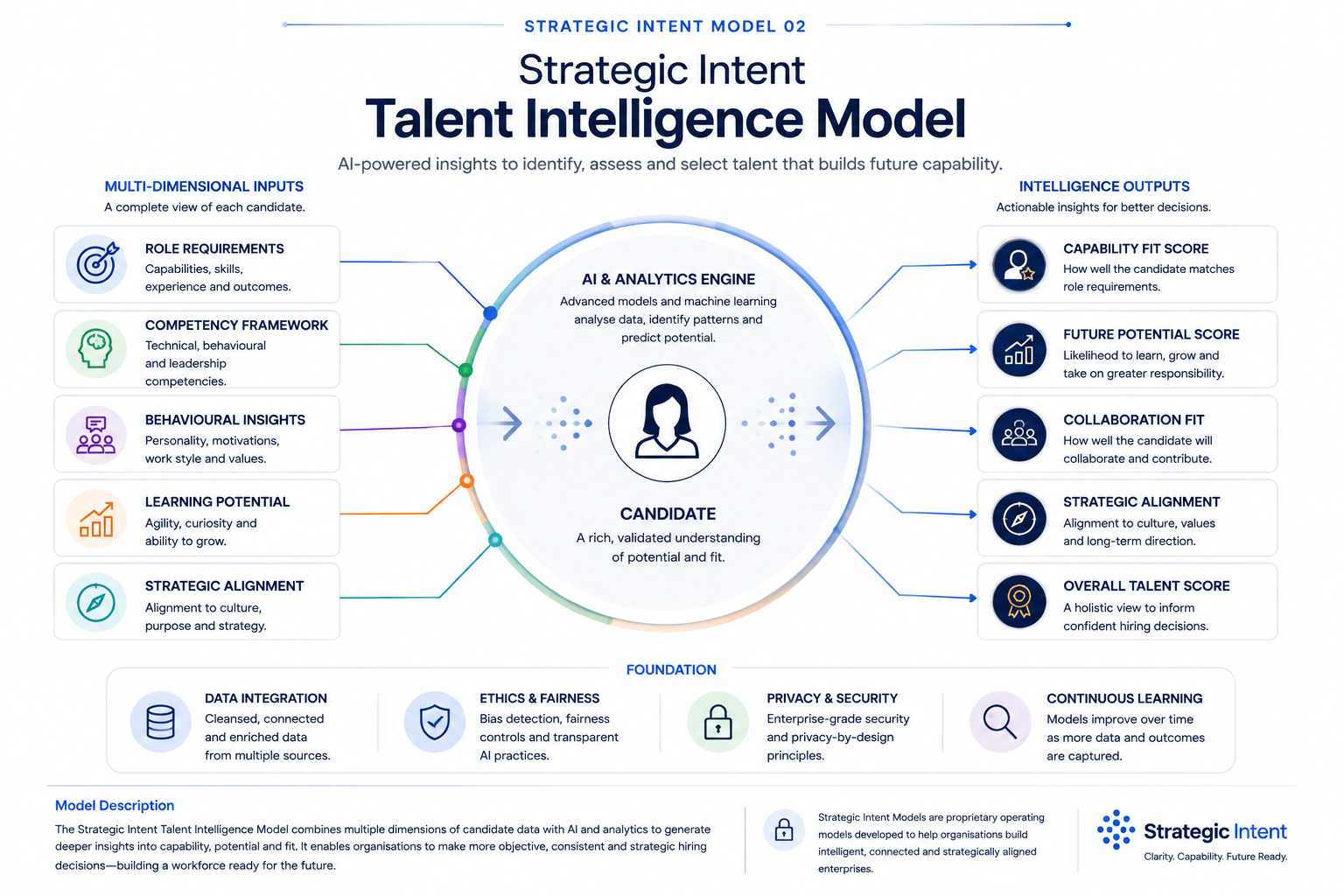
The Strategic Intent Talent Intelligence Model demonstrates how organisations can move beyond traditional CV matching to make more informed, future-focused hiring decisions. By combining role requirements, competency frameworks, behavioural insights, learning potential and strategic alignment with AI-assisted analysis, organisations develop a richer understanding of each candidate's ability to contribute both today and in the future.
The Strategic Intent Talent Intelligence Model illustrates how modern recruitment extends beyond matching candidates to job descriptions.
By combining role requirements, competency frameworks, behavioural assessment, learning potential, collaboration fit and strategic alignment, organisations develop a richer understanding of every candidate's potential contribution.
Rather than producing a simple "job match", this approach generates a comprehensive capability profile that supports better hiring decisions while strengthening long-term organisational capability.
Recruitment becomes an exercise in building future workforce capability rather than simply filling today's vacancies.
Building Strategic Talent Pipelines
The strongest organisations rarely recruit under pressure.
Instead, they build relationships with talented people long before opportunities arise.
Strategic talent pipelines enable organisations to identify, engage and nurture prospective candidates continuously.
Future vacancies can often be filled from an already qualified community of talent that understands the organisation, its culture and its strategic ambitions.
Rather than restarting recruitment every time a role becomes available, organisations build a living ecosystem of future capability.
Recruitment and Learning Should Never Be Separate
Hiring exceptional people is only the beginning.
Without continuous learning and development, even the best recruits struggle to realise their full potential.
Learning should begin before an employee's first day and continue throughout their career.
Recruitment, onboarding, learning, collaboration and performance should operate as one connected capability-building process.
When these activities are integrated, organisations accelerate development, retain organisational knowledge and improve workforce performance over time.
Strategic Intent Workforce Capability Lifecycle
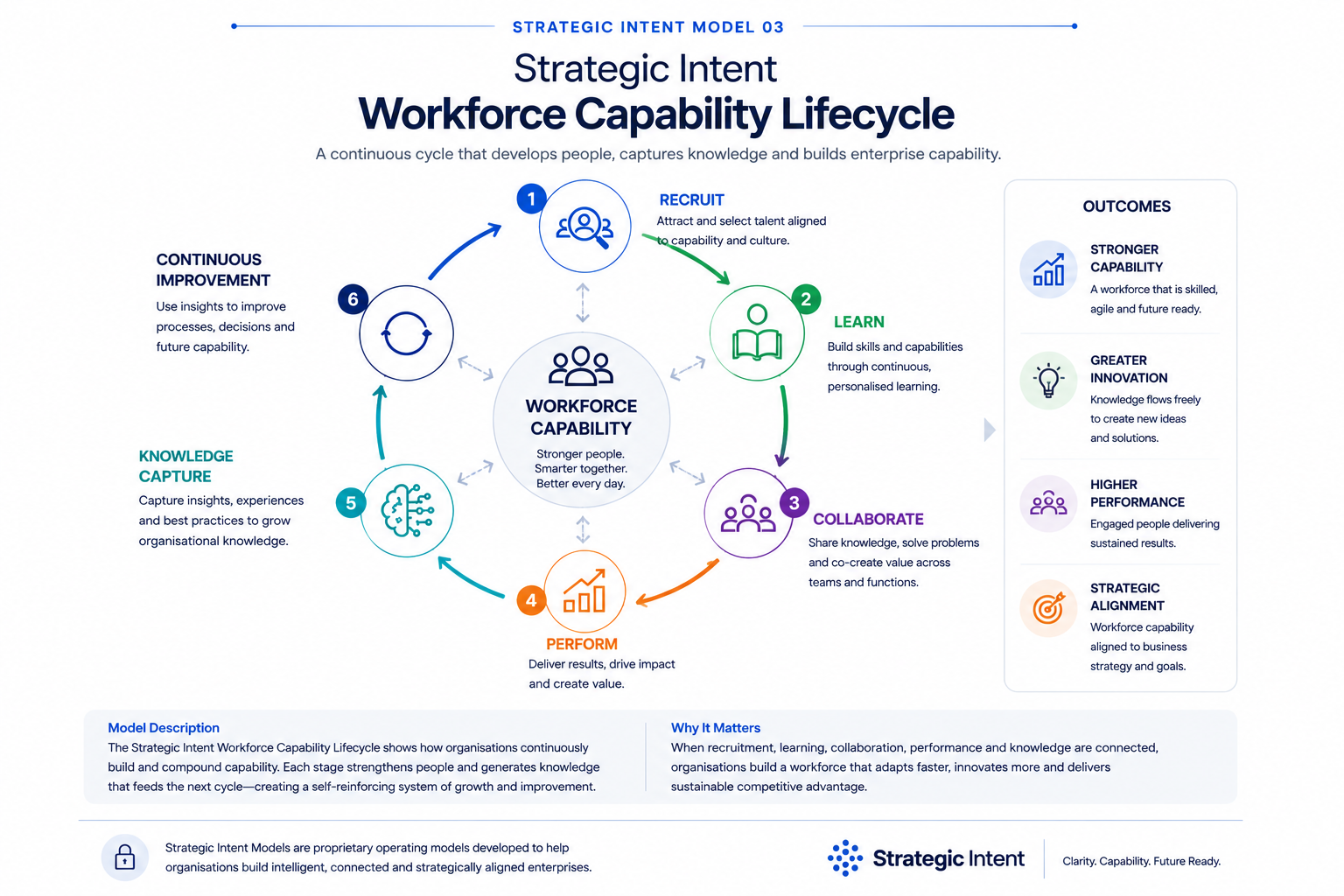
The Strategic Intent Workforce Capability Lifecycle demonstrates how leading organisations continuously develop, retain and strengthen workforce capability long after recruitment. By connecting learning, collaboration, performance, organisational knowledge and continuous improvement into a single operating lifecycle, every employee interaction contributes to stronger enterprise capability and better strategic outcomes.
The Strategic Intent Workforce Capability Lifecycle demonstrates how organisations continuously develop capability beyond recruitment.
Employees progress through learning, collaboration and performance while organisational knowledge is captured and reinvested into future workforce development.
Every interaction contributes to stronger organisational capability.
Every learning experience improves future performance.
Every collaboration creates new knowledge.
Over time, workforce capability compounds rather than resets.
Technology Should Enable Strategy
Technology alone does not transform organisations.
Successful workforce transformation begins with strategy, leadership and a clear understanding of the capabilities required to achieve future business objectives.
Only then should organisations select technology that enables their operating model.
Following extensive market evaluation, Strategic Intent has partnered with an industry-leading Talent Recruitment & Learning platform that provides the enterprise-grade capabilities required to support this methodology.
The platform combines AI-assisted recruitment, competency-based assessment, structured interview management, talent pipeline management, onboarding and continuous learning into a single, connected solution.
More importantly, it provides a trusted technology foundation that supports the broader Strategic Intent roadmap for intelligent workforce transformation.
Looking Ahead
Recruitment is only the first capability.
The future belongs to organisations that connect people, knowledge, collaboration and artificial intelligence into one intelligent operating model.
This vision is guiding the development of WorkSpaceOS - Strategic Intent's roadmap for building intelligent enterprises where every employee is supported by connected workspaces, enterprise knowledge and AI-powered Enterprise Advisors.
Organisations that begin strengthening workforce capability today will be better positioned to embrace the intelligent enterprise of tomorrow.
Key Takeaways
Recruitment should be viewed as the first stage of workforce capability development, not simply a hiring process.
AI is most valuable when it augments human judgement with competency, behavioural and strategic insights.
Strategic talent pipelines reduce recruitment risk while strengthening future workforce resilience.
Recruitment and learning should operate as one connected capability-building process.
Technology should enable an operating model—not define it.
WorkSpaceOS builds upon this foundation to create the intelligent, connected enterprise of the future.
Part 2 | From Workforce Capability to Enterprise Capability
Building a talented workforce is only the first step. The organisations that create lasting competitive advantage are those that connect people, knowledge, strategy and technology into a single enterprise capability.
In Part 2, we'll explore why successful transformation begins with strategy—not software—and how the Strategic Intent Enterprise Capability Architecture provides a practical blueprint for aligning workforce capability, organisational knowledge, artificial intelligence and business execution into one connected operating model.
Discover why the future belongs to organisations that engineer capability, not just implement technology.