The Strategic Intent Playbook Part 2 From Workforce Capability to Enterprise Capability
"Technology should never define strategy. Strategy should define the capabilities technology must enable."
What You'll Learn
In this playbook you'll discover:
Why many digital transformation programmes fail to deliver lasting value.
The difference between implementing technology and engineering organisational capability.
Why every technology investment should support strategic intent.
How connected operating models outperform disconnected applications.
The next step towards building an intelligent enterprise.
The Enterprise Technology Challenge
Over the past two decades, organisations have invested billions in enterprise technology.
CRM platforms.
ERP systems.
Human Resources systems.
Learning Management Systems.
Customer Experience platforms.
Knowledge bases.
Collaboration tools.
Artificial Intelligence.
Each promised to improve productivity.
Many delivered measurable benefits. Yet despite these investments, executives continue to ask the same questions.
Why is organisational knowledge still difficult to find?
Why are departments still working in silos?
Why do transformation programmes struggle to sustain momentum?
Why does every new initiative require another application?
The problem is rarely the technology itself.
The problem is that technology has often been implemented to optimise individual functions rather than strengthen enterprise capability.
Enterprise Capability Operating Model
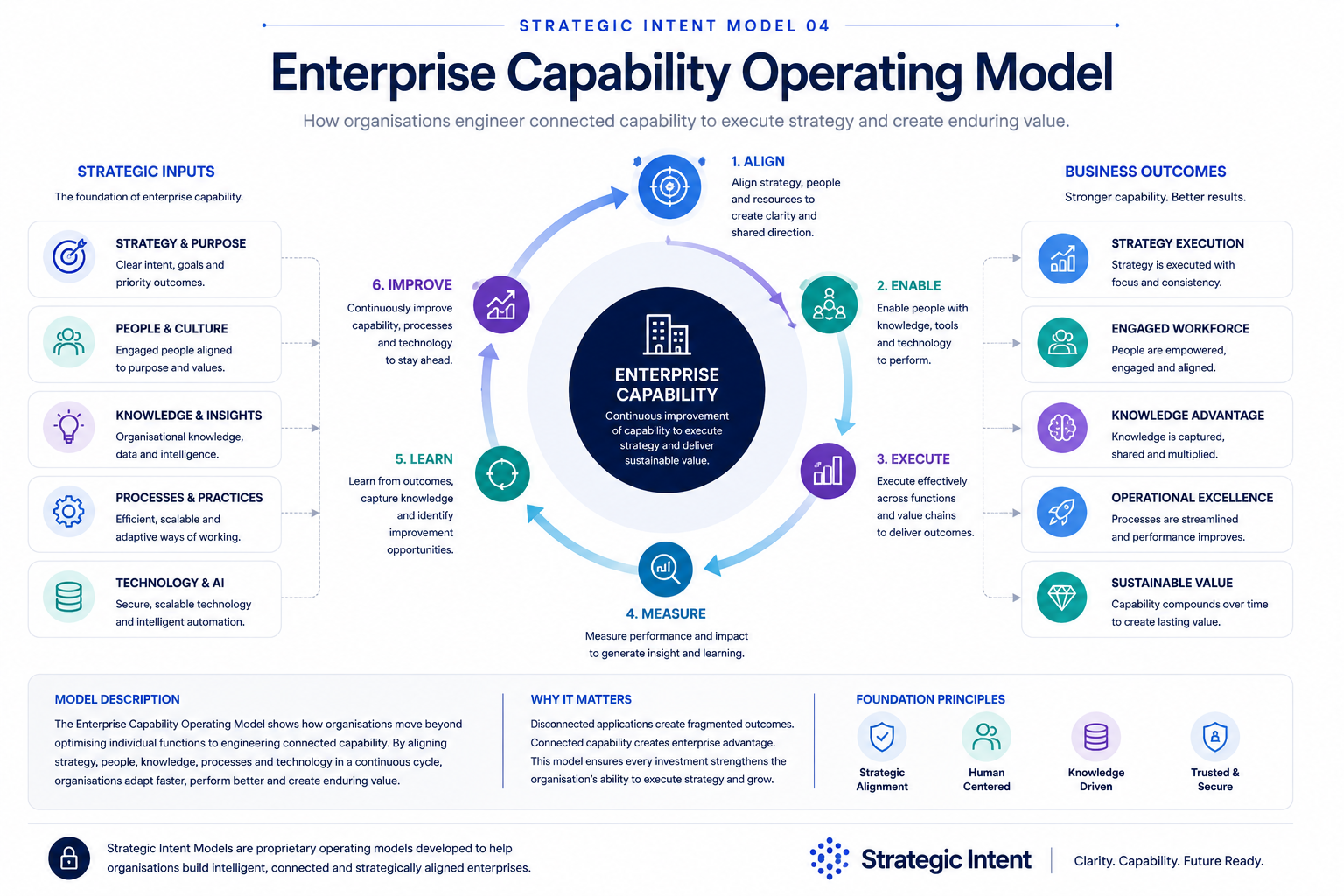
The Strategic Intent Enterprise Capability Operating Model demonstrates how organisations move beyond optimising individual business functions to engineering connected enterprise capability. Rather than implementing isolated applications, organisations create an operating model where people, knowledge, processes, AI and strategy continuously reinforce one another. Technology becomes an enabler of capability rather than a collection of disconnected systems.
The Shift from Digital Transformation to Capability Engineering
Digital transformation has traditionally focused on digitising existing processes.
Capability engineering asks a different question.
What capabilities must the organisation continuously develop to execute its strategy?
Once those capabilities are understood, technology becomes much easier to evaluate.
Instead of purchasing software to solve individual problems, organisations build a connected capability architecture where every investment strengthens the next.
From Applications to Capabilities
Most organisations purchase applications.
Leading organisations engineer capabilities.
Applications automate work.
Capabilities improve organisational performance.
Applications become obsolete.
Capabilities continue to grow.
Technology should therefore be selected based upon the capabilities it enables rather than the features it provides.
Enterprise Capability Architecture
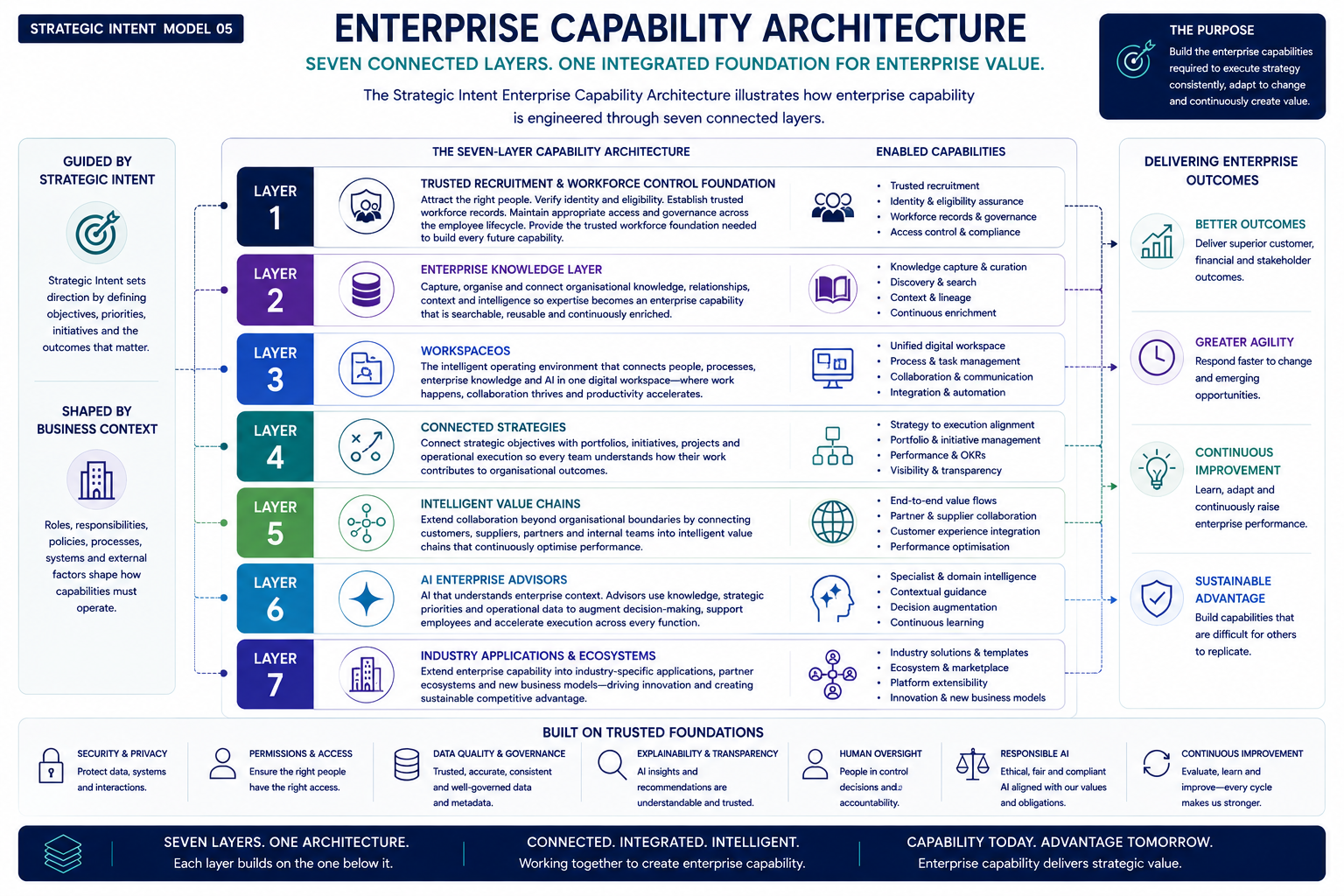
The Enterprise Capability Architecture is the blueprint for building intelligent, connected and future-ready enterprises. Rather than viewing technology as a collection of independent systems, it provides a structured operating model that aligns strategy, people, knowledge, artificial intelligence and execution into a single, continuously evolving enterprise capability.
Why Enterprise Capability Matters
Over the past two decades, organisations have invested heavily in enterprise technology to improve individual business functions. Human Capital Management systems optimise workforce processes. Enterprise Resource Planning systems improve operations. Customer Relationship Management platforms strengthen sales and service. Collaboration tools connect teams, while Artificial Intelligence promises new levels of productivity.
Yet despite these investments, many organisations continue to experience the same challenges.
Knowledge remains fragmented.
Business functions operate in silos.
Technology investments fail to realise their full potential.
Transformation programmes deliver isolated improvements rather than lasting organisational capability.
The problem is rarely the technology itself.
The problem is that technology has traditionally been implemented to solve individual business problems rather than build connected enterprise capability.
Organisations have accumulated applications.
Few have engineered an enterprise.
A Blueprint for the Intelligent Enterprise
The Strategic Intent Enterprise Capability Architecture provides a different approach.
Rather than starting with technology, it begins with capability.
Each layer of the architecture represents a strategic capability that strengthens the layers above it, creating an enterprise where every investment compounds the value of the next.
Instead of disconnected systems competing for attention, organisations develop a coherent operating model where technology, knowledge, people and artificial intelligence work together to execute strategy.
The architecture becomes the blueprint that guides both transformation and future technology investment.
Capability Model Description
The Strategic Intent Enterprise Capability Architecture illustrates how enterprise capability is engineered through seven connected layers.
Layer 1: Trusted Recruitment & Workforce Control Foundation
Every intelligent enterprise begins with trust, and that trust begins with the people who enter, operate within, and contribute to the organisation.
The Trusted Recruitment & Workforce Control Foundation establishes the trusted workforce upon which every subsequent enterprise capability depends. It ensures organisations can attract and select the right people, assess their competencies against current and future capability requirements, verify identity and eligibility, maintain trusted workforce records, and provide appropriate access to systems, information and organisational knowledge.
Recruitment therefore becomes more than the process of filling vacancies. It becomes the entry point into enterprise capability.
From the moment an individual enters the talent pipeline, the organisation begins building a trusted understanding of their skills, competencies, experience and potential. Once employed, that workforce intelligence can continue through onboarding, learning, performance, collaboration and capability development, creating continuity between the people an organisation recruits today and the capabilities it will require tomorrow.
Workforce control is equally important. As employees, contractors, partners and increasingly AI agents interact with enterprise systems and knowledge, organisations need confidence in who or what is accessing information, what they are authorised to do, and whether those interactions comply with organisational policies and governance requirements.
This makes identity, eligibility, permissions, security, compliance and workforce governance fundamental architectural capabilities rather than administrative controls.
The layer also creates the trusted workforce data required by everything built above it. The Enterprise Knowledge Layer needs confidence in identity and provenance. WorkSpaceOS requires secure, role-aware access. Connected Strategies depend upon clear accountability. Intelligent Value Chains require trusted participants. And AI Enterprise Advisors must understand who they are supporting, what that person is authorised to access and the organisational context in which recommendations are being made.
In this sense, Layer 1 establishes more than technological trust.
It establishes trusted participation in the enterprise.
Without a trusted foundation for recruitment, identity, workforce intelligence, access and governance, organisations may be able to deploy individual technologies, but they cannot confidently connect them into an intelligent enterprise.
Trust therefore comes before intelligence. And a trusted workforce becomes the foundation upon which enterprise capability can scale.
Layer 2: Enterprise Knowledge Layer
Knowledge is the organisation's most valuable strategic asset.
This layer captures organisational knowledge, relationships, context and intelligence so that expertise becomes an enterprise capability rather than remaining with individuals.
Knowledge becomes searchable, reusable and continuously enriched.
Layer 3: WorkSpaceOS
WorkSpaceOS provides the intelligent operating environment that connects people, processes, enterprise knowledge and AI into one digital workspace.
Rather than asking employees to navigate multiple applications, WorkSpaceOS becomes the environment where work happens.
Layer 4: Connected Strategies
Strategy should never exist only in executive presentations.
This layer connects strategic objectives with portfolios, initiatives, projects and operational execution, ensuring that every team understands how their work contributes to organisational outcomes.
Layer 5: Intelligent Value Chains
Organisations create value through connected relationships.
This layer extends collaboration beyond organisational boundaries by connecting customers, suppliers, partners and internal teams into intelligent value chains that continuously optimise performance.
Layer 6: AI Enterprise Advisors
Artificial Intelligence becomes exponentially more valuable when it understands enterprise context.
Enterprise Advisors use organisational knowledge, strategic priorities and operational data to augment decision-making, support employees and accelerate execution across every business function.
Rather than replacing people, AI amplifies human capability.
Layer 7: Industry Applications & Ecosystems
The final layer enables organisations to extend their capability into industry-specific applications, partner ecosystems and new business models.
Innovation becomes easier because every new capability builds upon a connected enterprise foundation.
Why This Architecture Matters
Most organisations implement technology one application at a time.
The Enterprise Capability Architecture demonstrates how organisations should build capability one layer at a time.
Every layer strengthens the next.
Every capability compounds organisational value.
Every technology investment supports a larger strategic vision.
This transforms digital transformation from a series of disconnected projects into a long-term programme of enterprise capability engineering.
The result is an organisation that learns continuously, adapts confidently and executes strategy with greater speed, intelligence and resilience.
The Strategic Intent Philosophy
Technology does not create competitive advantage. Capability does.
Technology is increasingly accessible to everyone; what differentiates an organisation is what it becomes capable of doing with it.
A competitor can buy the same CRM, deploy the same cloud platform, license the same AI model or implement the same recruitment system. The technology itself therefore rarely remains unique for long.
Competitive advantage emerges when technology is combined with things that are much harder to replicate: people, knowledge, processes, relationships, operating models, strategic alignment and accumulated organisational experience. Together, these create capability.
For example, two organisations could deploy exactly the same AI platform. One simply uses it to automate tasks. The other connects it to trusted enterprise knowledge, embeds it into workflows, develops its workforce to use it effectively, aligns it with strategic priorities and continuously learns from outcomes. They own essentially the same technology, but they have built very different capabilities.
Technology simply enables competitive advantage. Capability creates it.
The Enterprise Capability Architecture provides organisations with a practical blueprint for engineering that capability, ensuring every investment contributes to a more connected, intelligent and strategically aligned enterprise.
It is not simply a technology architecture. It is a blueprint for how modern enterprises can build enduring capability in an increasingly AI-driven world.
Why Enterprise Knowledge Changes Everything
Every organisation possesses enormous amounts of knowledge.
Unfortunately, most of it is locked inside documents, emails, meetings and the experience of individual employees.
When people leave, valuable capability often leaves with them.
The organisations that outperform competitors are those that transform individual knowledge into organisational capability.
Knowledge becomes a strategic asset.
Artificial intelligence amplifies its value.
Technology Partners Enable Capability
Technology should not dictate transformation.
Instead, organisations should select best-in-class platforms that support their operating model.
At Strategic Intent, this philosophy guides every technology partnership.
We work with proven technology providers whose platforms strengthen workforce capability, enterprise knowledge and intelligent collaboration while supporting a long-term roadmap towards the connected enterprise.
Looking Ahead
Building workforce capability is only the first step.
The next challenge is connecting people with organisational knowledge.
That is the focus of Part 3.
Next in the Strategic Intent Playbook
Part 3
Building an Enterprise Knowledge Layer
Discover why organisational knowledge has become the most valuable strategic asset in the age of Artificial Intelligence, and how leading organisations are transforming knowledge into a competitive advantage.