The Future of Work: Building the Connected Organisation

The future of work is not people being replaced by artificial intelligence. It is people and AI operating together within a connected, intelligent and human-centred organisation.
For many organisations, the future of work is still presented as a technology story: more automation, more digital tools and increasingly capable artificial intelligence.
This view is too narrow.
The deeper transformation is the emergence of the connected organisation, an organisation in which strategy, people, knowledge, capabilities, work, decisions and learning are connected within a shared enterprise intelligence system.
In this organisation, employees are not left to navigate disconnected applications, search through fragmented information or work out for themselves how their daily activities contribute to corporate priorities. They operate through an Intelligent Workspace supported by a context-aware Enterprise Advisor, an AI capability that understands the employee, the work being performed and the wider organisational purpose behind it.
The future of work is therefore not about replacing people with AI. It is about creating an environment in which people and AI can work together to improve judgement, accelerate learning, strengthen collaboration and build organisational capability.
From fragmented systems to a connected organisation
Most organisations have accumulated a large number of specialised systems. They have platforms for finance, HR, recruitment, learning, customer management, project delivery, communication and knowledge management.
Each system may perform its own function well, but the employee experience remains fragmented. Information is divided between departments and applications. Organisational knowledge is difficult to find. Previous decisions lose their context. Learning is separated from live work, and employees frequently cannot see how their role contributes to the organisation’s strategic objectives.
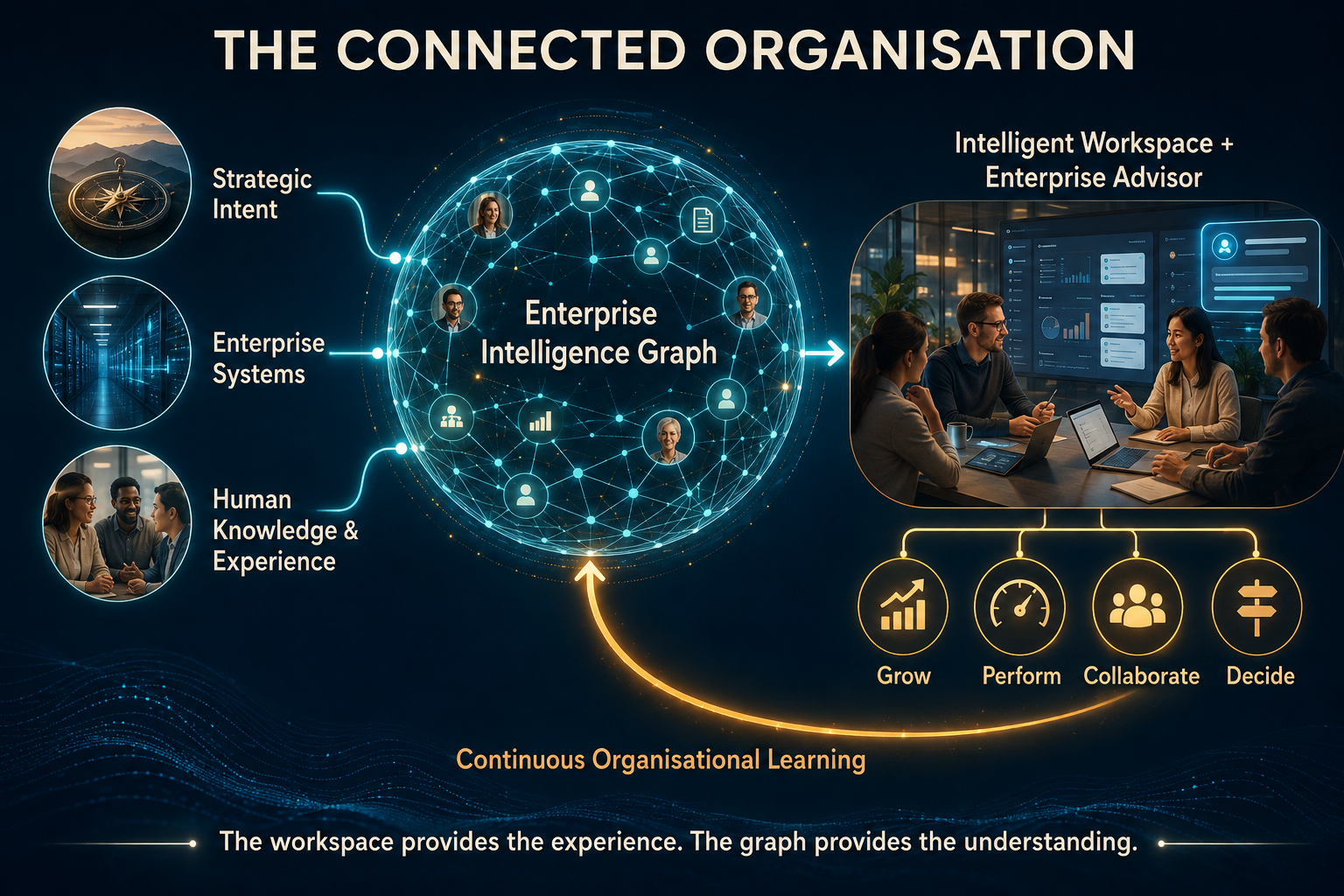
The connected organisation brings strategy, enterprise systems and human knowledge together through an Enterprise Intelligence Graph. The Intelligent Workspace and Enterprise Advisor then make this understanding available at the point of work, helping employees grow, perform, collaborate and make better decisions while continuously strengthening organisational learning.
The connected organisation addresses this fragmentation through an Enterprise Intelligence Graph.
The graph connects:
strategic objectives and business priorities;
organisational capabilities and skills;
employees, teams and external partners;
projects, processes and workflows;
knowledge, evidence and previous decisions;
learning resources and development opportunities;
customers, suppliers and other stakeholders;
operational outcomes and organisational performance.
This graph becomes a living form of organisational memory. It is continuously enriched through enterprise systems, work activity, knowledge, learning, human contribution and carefully governed AI inference.
The graph provides the understanding. The Intelligent Workspace provides the experience.
The Intelligent Workspace
The Intelligent Workspace is not simply another application or portal. It is the environment through which employees interact with the connected organisation.
It understands the employee’s role, responsibilities, skills, current work, development objectives and permissions. It also understands the relevant organisational strategy, project history, policies, relationships, risks and accumulated experience.
Within this environment, employees can receive support from an Enterprise Advisor: a context-aware AI capability working at the point of need.
The Enterprise Advisor could help an employee:
understand how a task contributes to a strategic objective;
locate relevant knowledge and subject-matter expertise;
prepare for a meeting or important decision;
identify dependencies, risks and affected stakeholders;
learn a skill while performing real work;
find colleagues with complementary experience;
capture the reasoning behind a decision;
recognise development opportunities arising from current assignments;
collaborate across departmental and professional boundaries.
This is different from a generic AI assistant. A generic assistant knows language and perhaps the information supplied in an individual prompt. An Enterprise Advisor understands authorised organisational context: the employee, the work, the organisation and the relationships between them.
It can therefore provide assistance that is relevant rather than merely plausible.
Helping people grow, perform and collaborate
The connected organisation brings employee development into the flow of work.
Traditional workplace learning is often organised around courses, catalogues and scheduled programmes. These remain valuable, but they are separated from the moment at which knowledge is most useful.
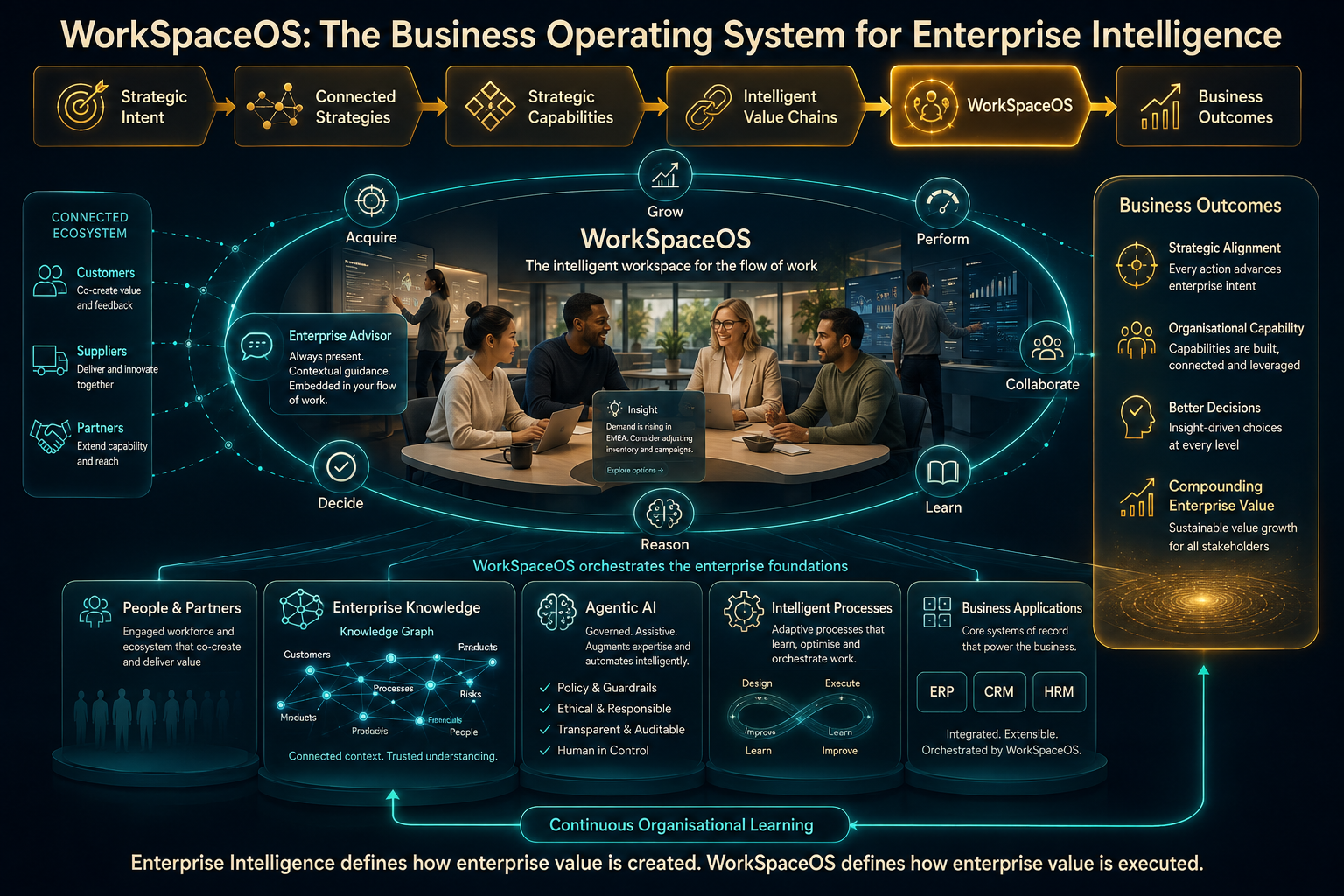
WorkSpaceOS: the Business Operating System for Enterprise Intelligence. WorkSpaceOS connects strategic intent to execution by orchestrating people, enterprise knowledge, agentic AI, intelligent processes and business applications within the flow of work. Through an embedded Enterprise Advisor, employees are supported to acquire, grow, perform, collaborate, learn, reason and decide—turning everyday work into better decisions, stronger organisational capability and compounding enterprise value.
A context-aware workspace can identify what an employee is trying to accomplish and recommend the knowledge, learning, coaching or human support needed at that point. Employees can develop capability through real projects, supported practice and reflection—not only through formal instruction.
Performance management can also become more continuous and constructive. Instead of relying mainly on retrospective annual reviews, the organisation can help employees understand expectations, identify obstacles, request support and recognise progress as work develops.
Collaboration improves because the system can connect people through capabilities, experience and shared purpose rather than relying entirely on organisational charts or personal networks. It can reveal who knows what, who has encountered a similar problem and which teams will be affected by a proposed decision.
The result is not simply greater individual productivity. It is stronger collective intelligence.
The strategic benefits
Strategically, the connected organisation reduces the distance between corporate intent and everyday action.
Leaders can communicate priorities through a system that connects strategy to capabilities, programmes, teams and work. Employees can see why an activity matters, not just what they have been asked to do. Decision-makers can understand where the organisation has the capability to deliver its strategy and where investment, recruitment or development is required.
The organisation becomes better able to adapt because it can learn from outcomes and feed that learning back into future decisions.
This creates a reinforcing cycle: better decisions lead to continuous learning; continuous learning builds capability; and stronger capability creates compounding enterprise value.
The political and governance benefits
Every organisation has a political dimension. Decisions affect authority, resources, status, opportunity and influence. Fragmented information can allow departmental interests, informal networks and hidden assumptions to shape decisions without sufficient scrutiny.
A connected organisation can make the relationship between evidence, decisions and outcomes more visible. It can clarify who contributed, who was consulted, what evidence was considered and how a decision supports strategic intent.
This does not remove disagreement or organisational politics. Nor should it. Constructive disagreement is essential to good governance. However, it can make organisational debate more informed, transparent and accountable.
At a wider public-policy level, connected organisations could also support better workforce planning, more responsive vocational education and closer cooperation between employers, colleges, universities and regional institutions. Skills policy could be informed by emerging capability requirements rather than relying only on historical job descriptions and delayed labour-market data.
These benefits depend upon strong governance. Employees must understand how information is used, which inferences are being made and how decisions can be questioned. AI must support accountable human judgement, not become an invisible authority.
The financial benefits
The financial value of the connected organisation extends beyond reducing headcount.
It can reduce the costs created by:
duplicated work;
repeated mistakes;
slow access to expertise;
poor handovers;
disconnected systems;
unsuitable recruitment;
underused employee capabilities;
irrelevant training;
weak project learning;
delays in decision-making;
the loss of knowledge when experienced employees leave.
It can also improve the return on investment in existing technology. Instead of replacing every enterprise system, the intelligence layer can connect information and relationships across them.
The largest financial gain may come from improved organisational capability: better decisions, faster innovation, stronger employee retention and a greater ability to execute strategy.
The operational benefits
Operationally, context-aware enterprise AI can provide the right knowledge and assistance at the point of work.
Employees spend less time searching for information, reconstructing past decisions or identifying the appropriate person to contact. Teams can detect dependencies earlier, coordinate across functions and retain the reasoning behind important actions.
When projects conclude, their experience does not disappear into archived documents. Outcomes, lessons and validated knowledge can strengthen the organisation’s collective memory.
The organisation therefore becomes more resilient. It is less dependent on isolated individuals, undocumented knowledge and informal communication channels.
The technical benefits
Technically, the connected organisation offers an alternative to building another monolithic enterprise platform.
The Enterprise Intelligence Graph can connect information held across existing systems while retaining clear permissions, provenance and ownership. Different AI models and specialist agents can operate through a governed intelligence layer rather than independently accessing uncontrolled stores of organisational data.
This architecture supports:
shared organisational context;
explainable relationships between information;
traceable sources and evidence;
role-based access controls;
reusable knowledge across applications;
interoperability between existing systems;
modular adoption of future AI capabilities;
continuous improvement without replacing the entire technology estate.
The objective is not to centralise every piece of data. It is to connect authorised knowledge sufficiently for people and AI to understand organisational context.
The cultural benefits
The cultural implications are equally important.
A connected organisation can move from a culture in which knowledge is protected as a source of individual power towards one in which useful knowledge is contributed to shared organisational capability.
Employees can receive greater recognition for coaching colleagues, documenting experience, improving processes and contributing knowledge—not only for completing visible individual tasks.
The organisation can also shift from periodic training to continuous development, from rigid job boundaries to capability-based collaboration, and from top-down information distribution to better-informed participation.
However, trust will determine whether this model succeeds. If employees believe the Intelligent Workspace is primarily a surveillance system, they will resist it or modify their behaviour around it. The system must be designed to support employees, make work more meaningful and expand human capability.
The connected organisation must remain human-centred by design.
The talent specialist as an architect of the future organisation
This transformation gives the talent specialist a central strategic role.
Recruitment in the connected organisation cannot remain a process of matching CV keywords to fixed job descriptions. The organisation must recruit for emerging capabilities, learning potential, adaptability, judgement, collaboration and the ability to work constructively with AI.
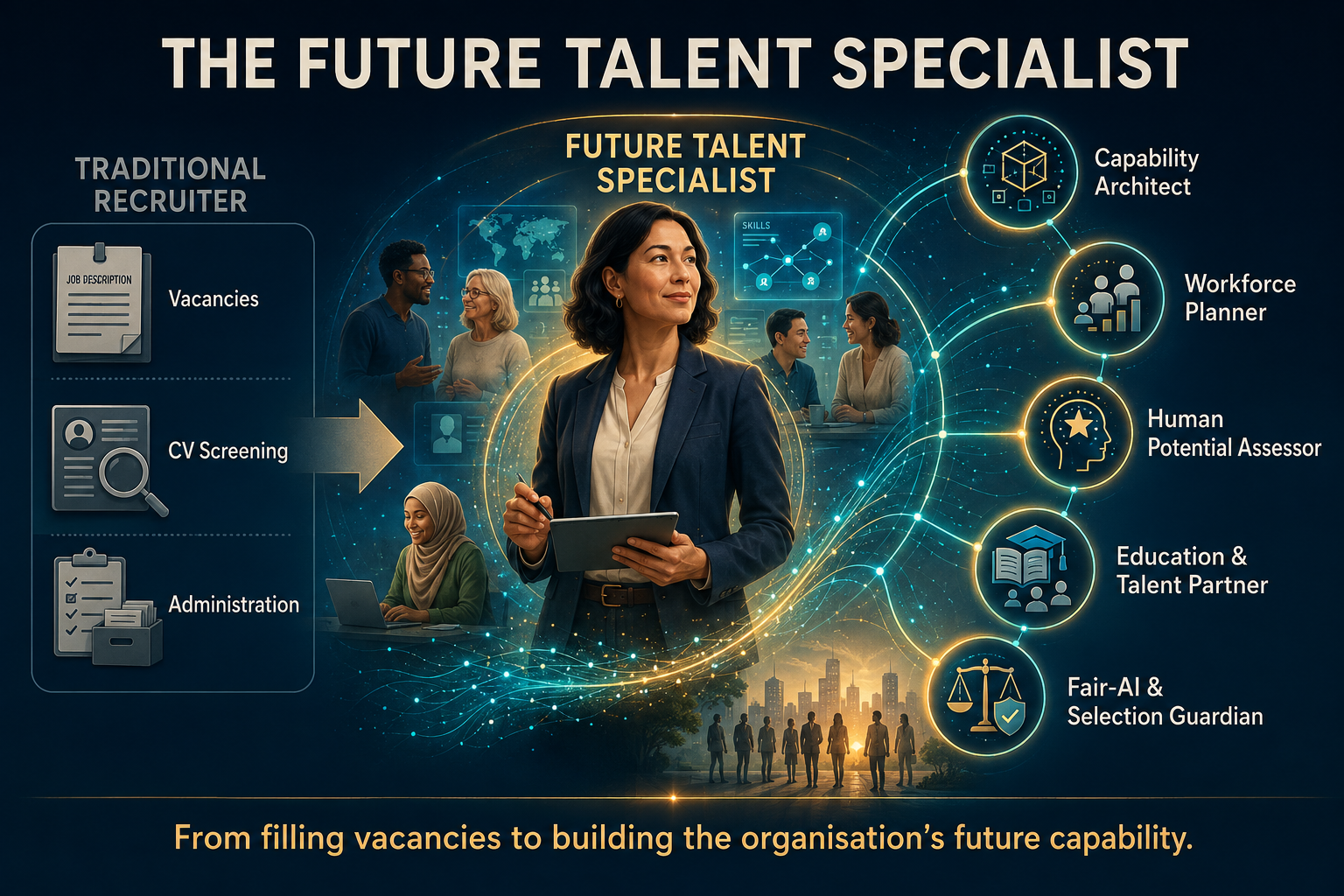
In the future organisation, the talent specialist moves beyond filling vacancies and processing applications. The role becomes strategically responsible for identifying future capabilities, understanding human potential, developing education and talent partnerships, guiding workforce planning and ensuring that AI-supported recruitment remains fair, explainable and human-centred.
The talent specialist becomes more than a recruiter. The role evolves into a combination of:
capability architect;
labour-market interpreter;
workforce planner;
talent relationship builder;
assessor of human potential;
advocate for fair and explainable selection;
connector between business strategy, education and workforce development.
Working with leaders and operational teams, the talent specialist can translate strategic ambitions into future capability requirements. They can identify which capabilities should be developed internally, which require external recruitment and which could be accessed through apprenticeships, partnerships or flexible talent networks.
AI can assist with labour-market analysis, candidate discovery, administration and workforce forecasting. But it should not be allowed to reduce people to a score or make unchallengeable decisions about human potential.
The talent specialist provides the judgement, curiosity and human understanding that automated systems cannot safely replace. They ensure that unconventional candidates are not excluded merely because their experience does not follow a familiar pattern. They also help candidates understand how roles are changing and what working within an AI-enabled organisation will require.
In this sense, the talent specialist becomes one of the principal designers of the future workforce.
A human-centred future of work
The future of work will not be determined by the capabilities of AI alone. It will be determined by how organisations connect technology with people, purpose, knowledge and learning.
The organisations that gain the greatest advantage will not necessarily be those that deploy the most AI tools. They will be those that develop the strongest Enterprise Intelligence: the capacity to connect what the organisation knows, what it is trying to achieve, what its people can do and what it learns through action.
The connected organisation offers a practical vision of that future.
Its Intelligent Workspace helps people perform. Its Enterprise Advisor provides assistance in context. Its intelligence graph preserves and connects organisational understanding. Its talent specialists build the capabilities the organisation will need next.
Together, these elements create more than a digital workplace. They create an organisation that can think, learn and develop, while keeping human judgement, growth and purpose at its centre.