Before the Future of Work: Fixing the Workforce Challenges Organisations Face Today
How governed recruitment, faster interviews, permanent workforce development and connected capability data can reduce costs today while preparing the organisation for WorkSpaceOS tomorrow
The future of work is increasingly described as intelligent, connected and enabled by artificial intelligence. Yet many organisations are still struggling with more immediate workforce problems.
Permanent vacancies remain open for too long. Suitable applicants wait weeks to be interviewed. Recruiters, hiring managers and interview panels coordinate appointments through disconnected emails and calendars. Strong candidates who narrowly miss one opportunity disappear from the organisation’s talent pipeline. Recruitment evidence is rarely carried forward into onboarding, learning or employee development.
During the delay, the consequences accumulate.
Departments operate below capacity. Existing employees carry additional workloads. Overtime and agency costs increase. Projects and services are delayed. In healthcare, persistent vacancies can affect workforce continuity, service capacity and potentially the experience and outcomes of patients.
Before organisations can realise the future of work, they must fix the workforce challenges they face today.
Workforce: the foundational platform
Workforce is a governed recruitment, workforce-capability and learning platform focused initially on helping organisations fill permanent full-time-equivalent positions.
It connects:
workforce requirements and approved vacancies;
job-board distribution and direct applications;
applications imported from Workday or another ATS;
CV screening and competency questionnaires;
human-controlled shortlisting;
candidate communications;
interview and panel scheduling;
structured assessments;
verification and right-to-work processes;
hiring decisions and offers;
qualified candidate pipelines;
compliance and onboarding;
current-role development;
preparation for future promotional roles.
The platform addresses immediate operational and financial problems while creating trusted information about people, roles, capabilities, learning and decisions.
This becomes the workforce foundation for future Workforce Advisors and WorkSpaceOS.
Start with the capability requirement
Traditional recruitment systems generally begin with a vacancy. Workforce begins by asking why the organisation needs the position and what capability it is intended to provide.
A workforce requirement can be connected to:
a strategic objective;
an operational requirement;
a service-capacity need;
a capability gap;
a replacement requirement;
geographic expansion;
organisational growth;
regulatory or compliance obligations.
The organisation can then consider whether the requirement should be addressed through recruitment, internal progression, employee development or redeployment.
This changes the central question from: “How do we fill this vacancy?”
to “What capability does the organisation need, and what is the most effective way to obtain it?”
From application to interview in days
Much of the delay in recruitment is not caused by a lack of candidates. It is caused by fragmented administration.
Workforce reduces avoidable delays through approved hiring workflows that coordinate the recruitment journey from the moment a vacancy is authorised.
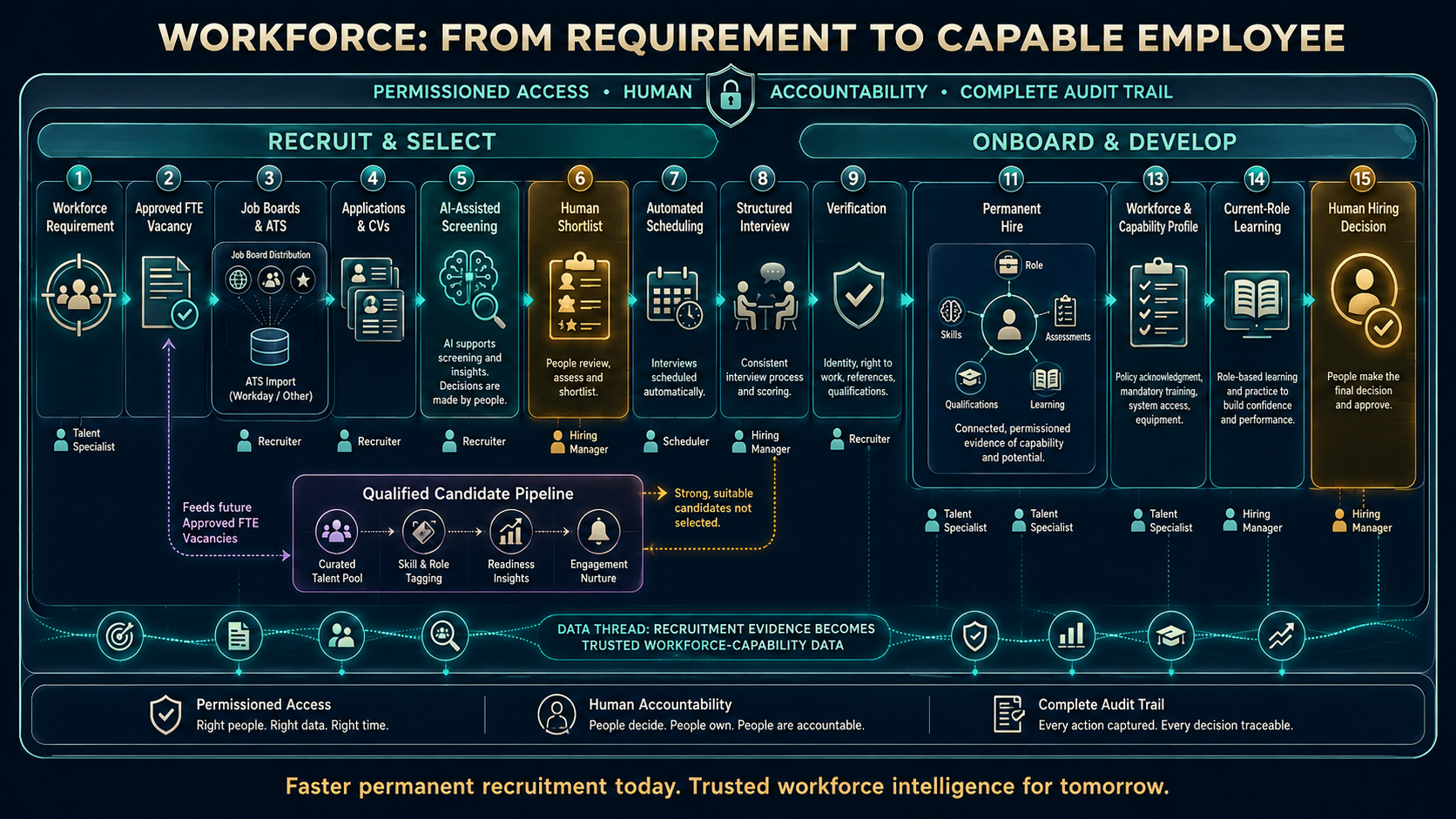
Workforce coordinates the complete journey from an approved permanent workforce requirement to a capable employee—combining AI-assisted efficiency with permissioned access, accountable human decisions and a complete audit trail.
The platform can:
publish a vacancy across selected job boards and careers sites;
receive applications and CVs directly;
import applications from Workday or another ATS;
preserve the original source of every candidate;
confirm receipt automatically;
distribute competency questionnaires;
organise CV and questionnaire evidence against approved criteria;
support recruiters with explainable candidate matching;
present evidence to an accountable human shortlister;
collect candidate availability;
connect with hiring-manager and panel calendars;
propose suitable interview appointments;
issue invitations, reminders and joining instructions;
coordinate cancellations and rescheduling;
retain a complete record of every action.
The objective is to move suitable candidates from application to interview in a few days rather than several weeks.
Faster does not mean less controlled. AI assists with organising evidence and identifying possible matches, while authorised people remain accountable for shortlisting and hiring decisions.
Interested in reducing time to interview, permanent vacancy costs and agency dependence? Explore how a Workforce pilot could be configured around your organisation’s recruitment workflows, governance requirements and business systems.
A workflow designed for every role
Different positions require different recruitment journeys.
A standard administrative role may require one interview and basic verification. A regulated healthcare position may require professional registration, employment-history checks, occupational-health clearance, references, safeguarding checks and mandatory learning. A senior leadership role may require several assessment and panel stages.
Workforce allows an approved workflow to be selected when a vacancy is created.
The workflow can determine:
application questions;
competency questionnaires;
screening criteria;
assessment dimensions;
required approvals;
interview stages;
interview-panel composition;
verification requirements;
right-to-work stages;
candidate communications;
offer conditions;
onboarding and learning requirements.
The hiring process is therefore configured correctly from the beginning rather than improvised as candidates progress.
Permissioned workflows: automation with human accountability
Workforce is designed to automate recruitment preparation, evidence processing, candidate communication and interview coordination. It does not automate accountability.
Each participant receives access to the information and actions required for their authorised purpose. The platform prepares, organises and coordinates the work; Talent Specialists, Recruiters, Schedulers and Hiring Managers review, approve and remain responsible for consequential decisions.
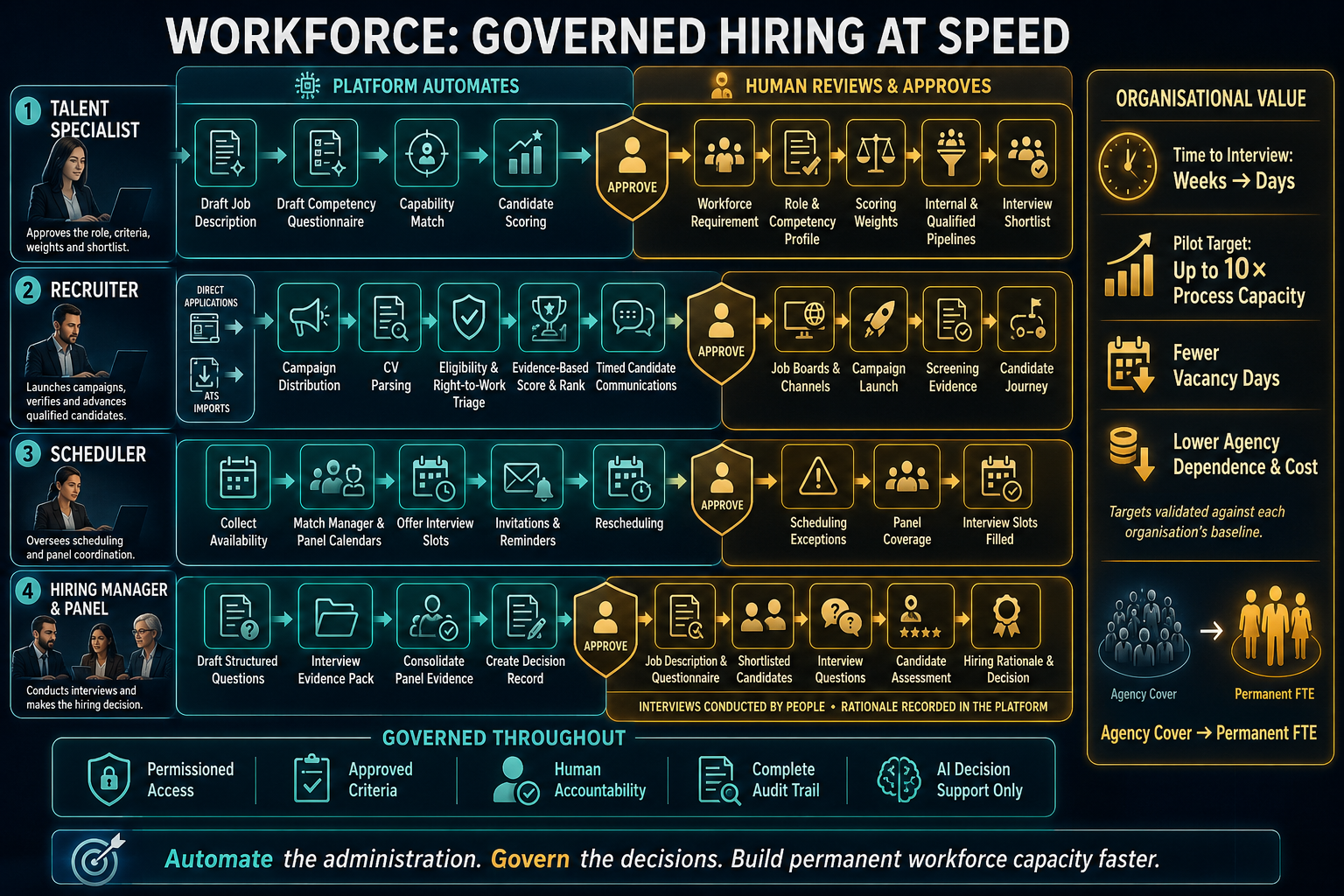
Workforce automates recruitment preparation, campaign administration, evidence processing, candidate communications and interview coordination, while authorised Talent Specialists, Recruiters, Schedulers and Hiring Managers retain approval and accountability. The objective is to reduce time to interview from weeks to days, expand recruitment capacity and accelerate the replacement of costly agency cover with permanent FTE capability.
The Talent Specialist
The Talent Specialist connects recruitment to the organisation’s Strategic Intent, workforce requirements and future capability needs.
The platform can assist the Talent Specialist by:
analysing an approved workforce requirement;
generating a draft job description;
generating a draft competency questionnaire;
comparing the requirement with existing capability profiles;
identifying potential internal candidates;
searching qualified candidate pipelines;
proposing technical, behavioural, learning, collaboration and strategic-contribution criteria;
producing an initial scoring model;
presenting evidence-based candidate scores and rankings;
identifying capability gaps and possible development pathways.
The Talent Specialist remains responsible for:
confirming the workforce and capability requirement;
reviewing and approving the job description;
reviewing and approving the competency questionnaire;
approving the role and capability profile;
setting and approving the weighting applied to assessment criteria;
reviewing internal candidates and qualified candidate pipelines;
reviewing the evidence supporting the platform’s candidate rankings;
overseeing the recruitment process;
reviewing the Recruiter’s proposed shortlist;
approving the shortlist for Hiring Manager consideration;
connecting recruitment evidence with onboarding, current-role learning and future progression.
The Talent Specialist does not require unrestricted access to sensitive identity, health, right-to-work or verification documents. Access is granted only where it is necessary for an authorised purpose.
The Recruiter
The Recruiter manages the recruitment campaign and the end-to-end candidate journey.
Once the role, competency profile and hiring workflow have been approved, the platform can:
prepare the recruitment campaign;
distribute the vacancy to selected careers sites and job boards;
receive direct applications;
import applications and CVs from Workday or another ATS;
preserve the source and provenance of every candidate;
parse CVs and organise evidence against approved criteria;
issue competency questionnaires;
conduct eligibility and right-to-work triage using the organisation’s approved rules;
support evidence-based scoring and ranking;
identify possible duplicate candidate records;
confirm receipt of applications;
send timed communications throughout the candidate journey;
request missing information;
notify candidates of progress and next steps;
maintain qualified candidate pipelines.
The Recruiter remains responsible for:
selecting the authorised job sites and recruitment channels;
reviewing and launching the campaign;
monitoring application quality and campaign performance;
reviewing CV, questionnaire and eligibility evidence;
investigating exceptions or incomplete information;
reviewing the platform’s scores and recommendations;
proposing a shortlist supported by evidence;
ensuring candidates are kept appropriately informed;
referring the proposed shortlist to the Talent Specialist;
recording decisions, reasons and authorised changes.
The platform must not reject or appoint a candidate autonomously. Screening and ranking provide decision support; authorised people make and own the decisions.
Once candidates have entered the process, approved criteria, scoring weights and workflow rules cannot be changed silently. Any authorised change is versioned, justified and recorded in the audit trail.
The Scheduler
The Scheduler oversees interview coordination while the platform performs the time-consuming calendar administration.
Once a candidate has been approved for interview, the platform can:
collect the candidate’s availability;
access permitted Hiring Manager and panel availability;
identify suitable interview combinations;
offer approved interview slots;
coordinate individual and multi-person panel interviews;
reserve rooms or create virtual meeting links;
issue invitations and joining instructions;
send reminders;
manage routine cancellations and rescheduling;
flag scheduling conflicts and unfilled interview slots.
The Scheduler remains responsible for:
monitoring the scheduling process;
resolving exceptions that cannot be handled automatically;
ensuring the required Hiring Manager and panel representation is available;
confirming that interview slots are filled;
addressing delays or availability problems;
ensuring candidates receive accurate and timely information.
The Scheduler normally receives scheduling information only. They do not need access to full CVs, questionnaire responses, candidate rankings, interview scores, protected information or hiring recommendations.
This purpose-limited access enables the Scheduler to coordinate interviews efficiently without gaining unnecessary access to selection evidence.
The Hiring Manager and Interview Panel
The Hiring Manager is accountable for determining whether a candidate meets the requirements of the approved position. Panel members contribute structured evidence within their authorised assessment responsibilities.
Before the campaign begins, the Hiring Manager can:
review and approve the job description;
review and approve the competency questionnaire;
confirm the role requirements;
confirm the required interview stages;
identify the appropriate panel composition;
approve the structured assessment approach.
During shortlisting, the platform can present:
candidates approved by the Talent Specialist;
relevant CV and questionnaire evidence;
the criteria applied;
candidate scores and rankings;
identified strengths and capability gaps;
the provenance of the supporting evidence.
The Hiring Manager remains responsible for reviewing this evidence and approving which shortlisted candidates proceed to interview.
Before the interview, the platform can:
generate draft structured interview questions from the approved role and competency profile;
produce a consistent interview evidence pack;
allocate questions or assessment areas to authorised panel members;
provide an approved scoring framework.
The Hiring Manager and panel remain responsible for:
reviewing and approving the interview questions;
conducting the interview;
applying the approved assessment criteria;
recording scores, observations and evidence;
identifying any required follow-up;
completing their assessments independently where appropriate.
After the interview, the platform can consolidate authorised panel evidence and prepare a structured decision record. It may highlight agreement, differences in assessment, missing evidence or areas requiring further discussion.
The Hiring Manager and authorised panel members remain responsible for:
evaluating the consolidated evidence;
agreeing the candidate assessment;
recording the selection rationale;
approving progression, hold or rejection decisions;
making the final accountable hiring recommendation;
identifying capability gaps that should inform onboarding and development;
approving the initial current-role learning plan following appointment.
Where a Hiring Manager overrides a platform recommendation, shortlist assessment or panel conclusion, the reason is recorded. The platform preserves the evidence and rationale; it does not substitute its judgement for that of the accountable decision-makers.
The Hiring Manager’s access is restricted to vacancies and candidates for which they hold an authorised responsibility. They cannot search unrelated candidate records, view unnecessary protected information or alter evidence submitted by another assessor.
Governed hiring at speed
This combination of automation and human approval enables Workforce to increase recruitment capacity without weakening control.
The platform automates:
document and questionnaire preparation;
campaign distribution;
CV parsing and evidence organisation;
approved scoring and ranking;
candidate communications;
availability collection;
calendar coordination;
interview-pack preparation;
panel-evidence consolidation;
audit-record creation.
People continue to govern:
workforce requirements;
role and competency definitions;
scoring criteria and weights;
candidate shortlists;
interview questions;
assessments;
hiring rationales;
final employment decisions.
The objective is to reduce time to interview from weeks to days, shorten permanent vacancy periods and help large organisations replace costly long-term agency dependence with substantive FTE capability.
Any target, such as increasing recruitment-process capacity by up to ten times, should be measured and validated against the organisation’s existing baseline during the pilot.
Permissioned workflows create separation of duties, protect candidate information and establish clear accountability. The audit record can show:
Who accessed what, for which authorised purpose, when they accessed it, what the platform recommended and what action the authorised person took.
Qualified candidates should not be lost
A recruitment campaign may identify several candidates capable of performing the role, even though only one position is available.
Candidates who successfully complete CV screening, competency assessment, interview and relevant verification but are not selected because another candidate was preferred can, with their permission, enter a Qualified Candidate Pipeline.
They can then be considered for:
the same role in another location;
a comparable permanent position;
a future vacancy;
an opportunity elsewhere within the organisation;
another participating organisation where explicit candidate consent has been obtained.
The platform distinguishes between candidates who are qualified, interviewed, verified, right-to-work checked and currently available. It also records when checks or certifications expire.
This allows organisations to return to credible candidates quickly rather than restarting every recruitment campaign from the beginning.
From candidate evidence to employee capability
Recruitment generates valuable information that is usually discarded or left inside an ATS.
Workforce uses approved recruitment evidence to create the successful candidate’s initial Workforce Capability Profile.
Evidence can be gathered from:
the job description;
the candidate’s CV;
competency questionnaires;
technical assessments;
behavioural assessments;
interviews;
qualifications;
certifications;
verification checks.
Once the candidate is hired, this information helps identify four learning requirements:
Compliance learning required by the organisation, sector or role.
Onboarding learning needed to understand the organisation and working environment.
Current-role development required to close gaps affecting performance.
Next-role development that prepares the employee for future progression.
Employees receive access to these materials through the learning system. Their capability profile then develops through completed learning, certifications, work experience and validated achievement.
Recruitment becomes the beginning of workforce development rather than a disconnected transaction.
Strategic benefits
Workforce connects hiring decisions to strategic intent.
It allows organisations to understand which people and capabilities are required to deliver their priorities, where those capabilities are currently missing, and whether they should be recruited or developed.
Over time, Workforce can provide a clearer view of:
workforce requirements;
capability coverage;
geographic shortages;
qualified candidate availability;
development needs;
promotion readiness;
future workforce risks.
The objective is no longer simply to have the right number of people. It is to ensure the organisation possesses the right capabilities at the right time.
Political and governance benefits
Recruitment decisions affect opportunity, representation, organisational power and public trust.
Workforce establishes approved criteria, permissioned responsibilities, human accountability and a complete audit trail.
The organisation can reconstruct:
which workflow was selected;
which criteria were applied;
what evidence was considered;
how AI supported the process;
who reviewed the recommendation;
whether an override occurred;
who participated in the interview;
why the final decision was made;
what was communicated to the candidate.
This makes the process more consistent, explainable and accountable without removing legitimate human judgement.
Financial benefits
Every day that a permanent role remains vacant can create financial consequences:
agency cover;
overtime;
recruitment-agency fees;
repeated advertising;
management administration;
lost capacity;
delayed work;
increased pressure on existing employees.
By reducing time to interview and appointment, Workforce can shorten the period during which these costs accumulate.
It can also measure:
time from application to shortlist;
time from application to interview;
total time to hire;
vacancy days;
agency expenditure associated with the vacancy;
estimated agency costs avoided;
recruiter and manager time saved;
cost per interview;
cost per permanent hire;
vacancies filled from qualified pipelines.
These measures turn recruitment improvement into a visible business case.
Operational benefits
Workforce creates one coordinated candidate journey.
Candidates know that their application has been received, what stage they have reached, what is required next and when their interview will take place.
Recruiters, hiring managers, schedulers and interview panels work through clearly defined workflows rather than disconnected spreadsheets, emails and calendars.
Organisations can recruit faster while retaining consistent controls across departments, roles and locations.
Technical benefits
Workforce creates a shared and governed model for:
candidates;
employees;
roles;
positions;
applications;
capabilities;
assessments;
learning;
qualifications;
workflows;
decisions;
permissions;
audit events.
It can manage recruitment campaigns directly or connect to Workday and other applicant-tracking systems. Imported records retain their source, external identifier, consent information and recruitment history.
An API-first, event-based architecture allows Workforce to connect with job boards, careers sites, calendars, enterprise applications and future AI services without requiring an organisation to replace its entire technology estate.
Cultural benefits
A better recruitment system also creates a better workforce culture.
Candidates receive timely and respectful communication. Strong unsuccessful candidates remain visible—with their permission—as sources of future capability. Employees can see how development supports their current performance and future progression.
Managers become accountable not only for selecting a person, but also for helping that person acquire the capabilities needed to succeed.
People are treated as developing sources of organisational capability rather than CVs processed for a single vacancy.
Healthcare: permanent recruitment, financial value and patient services
Healthcare organisations face particularly significant consequences when permanent roles remain vacant.
Vacancies may increase reliance on agency cover and overtime, place additional pressure on existing teams and reduce workforce continuity. Accelerating permanent recruitment can help restore substantive staffing capacity sooner.
Workforce can configure healthcare hiring workflows around professional registration, qualifications, references, employment history, occupational health, safeguarding, right-to-work requirements and mandatory learning.
By helping suitable candidates reach interview and appointment sooner, Workforce can support reduced agency dependence, stronger team continuity and more consistent service capacity.
The platform should not claim to improve patient outcomes directly. The responsible argument is that faster permanent recruitment can strengthen staffing capacity and continuity, which may contribute to improved patient experience, service quality and outcomes.
Building the foundation for WorkSpaceOS
Workforce does not attempt to create the entire Intelligent Enterprise on its first day.
It addresses the problems organisations face now:
permanent vacancies;
slow recruitment;
agency dependence;
fragmented candidate journeys;
capability gaps;
inconsistent governance;
disconnected recruitment and learning information.
At the same time, it creates something the future organisation cannot operate without: trusted, permissioned and continuously developing information about its people and capabilities.
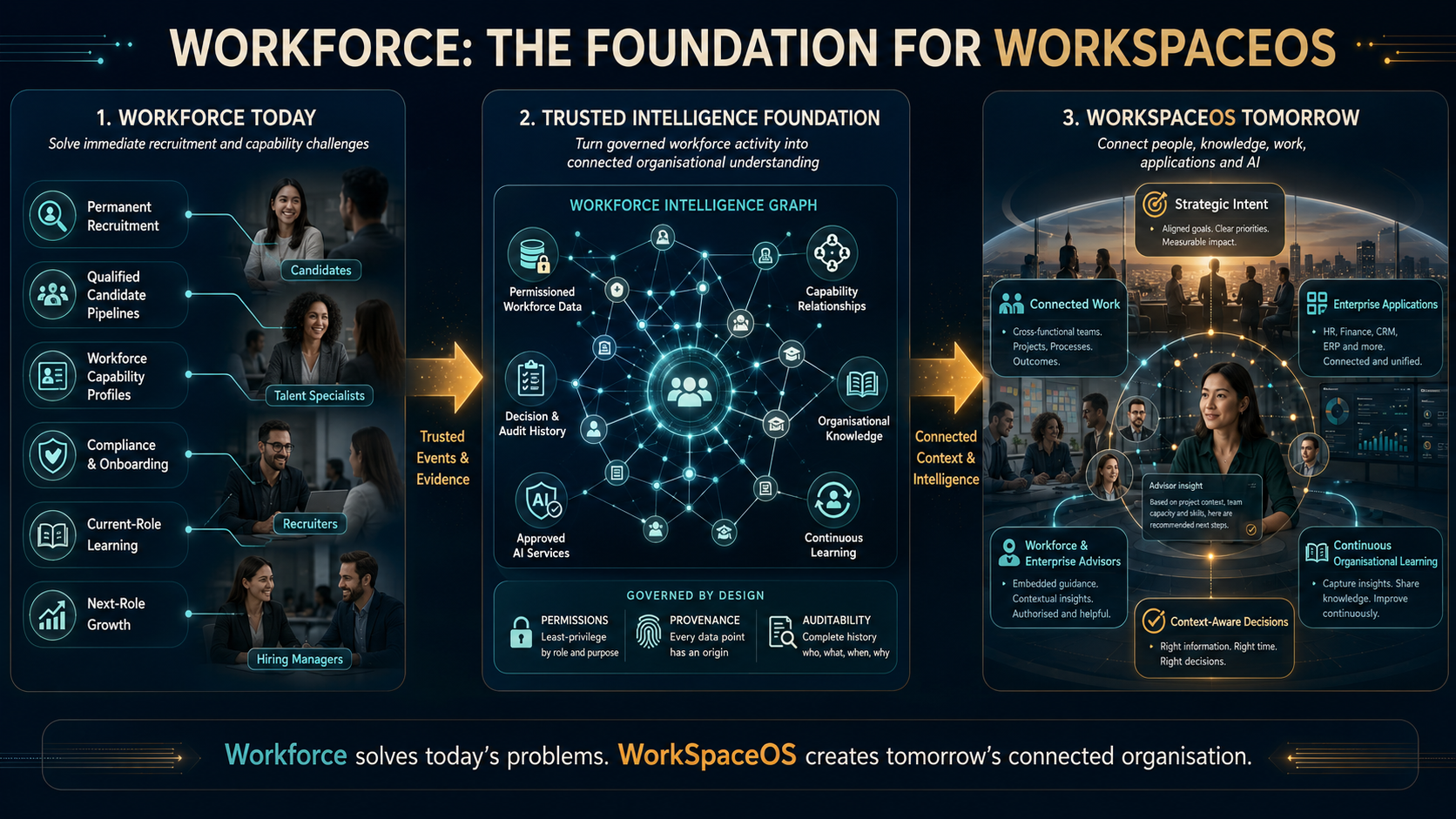
Workforce addresses today’s permanent recruitment, capability and learning challenges while creating a trusted, permissioned intelligence foundation. WorkSpaceOS builds on that foundation to connect people, organisational knowledge, work, enterprise applications and context-aware Advisors across the future organisation.
Configured around the client’s Strategic Intent and connected to its authorised business applications, this information becomes part of the foundation for Workforce Advisors and WorkSpaceOS.
The journey is therefore practical and progressive:
Workforce solves today’s recruitment and capability problems while creating the trusted workforce foundation. WorkSpaceOS connects people, knowledge, work, applications and AI across the organisation. Within that connected environment, context-aware Workforce and Enterprise Advisors help employees, managers and leaders make better decisions.
Before organisations can realise the future of work, they must establish the workforce foundations that make that future possible.