Validating Workforce Before Enterprise Rollout
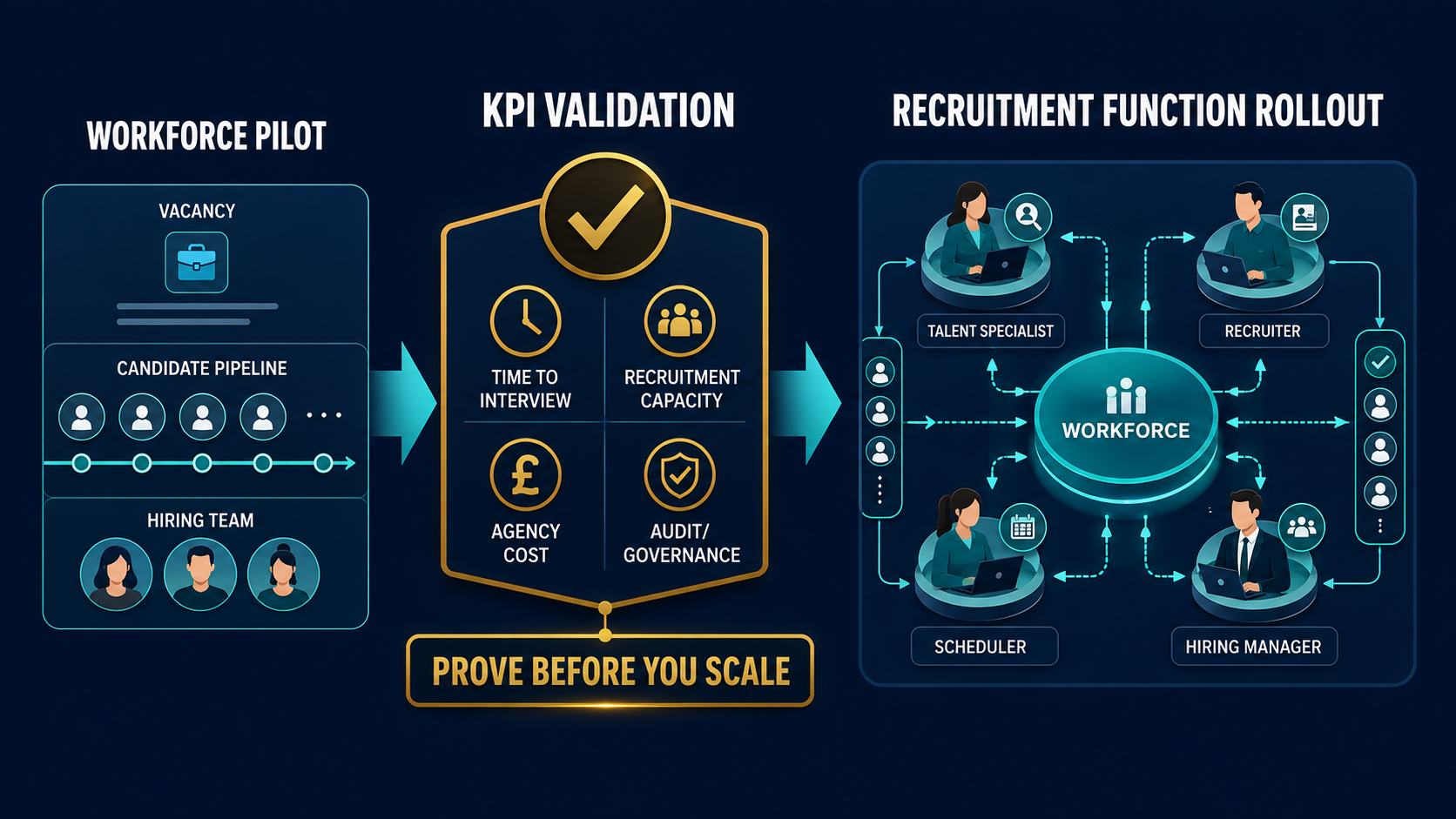
Workforce validates time to interview, recruitment capacity, agency-cost reduction and governance before rollout across the Talent Specialist, Recruiter, Scheduler and Hiring Manager workflows.
Introducing a new workforce platform requires objective evidence that it can deliver measurable benefits without disrupting existing operations, weakening governance or creating unnecessary implementation risk.
Workforce can therefore be introduced through a controlled validation pilot focused on one business unit, geography or priority FTE role family.
The purpose of the pilot is to validate agreed key performance indicators before an enterprise rollout is considered.
The organisation would not need to replace its existing ATS or HR system during the validation period. Workforce could initially operate alongside platforms such as Workday, importing authorised vacancy and candidate data while preserving the existing system of record.
Configured Around the Organisation
Workforce can be configured and, where required, customised to reflect the organisation’s precise operating requirements, including:
workforce and capability models;
organisational structures and approval authorities;
role-specific hiring workflows;
job descriptions and competency questionnaires;
candidate assessment criteria and scoring weights;
permissioned Talent Specialist, Recruiter, Scheduler and Hiring Manager workflows;
candidate communications and scheduling rules;
right-to-work and verification processes;
security, retention and audit requirements;
existing ATS, HR, learning and business applications.
Customisation would take place within an agreed scope and change-control process. This allows Workforce to fit the organisation’s operating model while preserving platform integrity, governance and upgradeability.
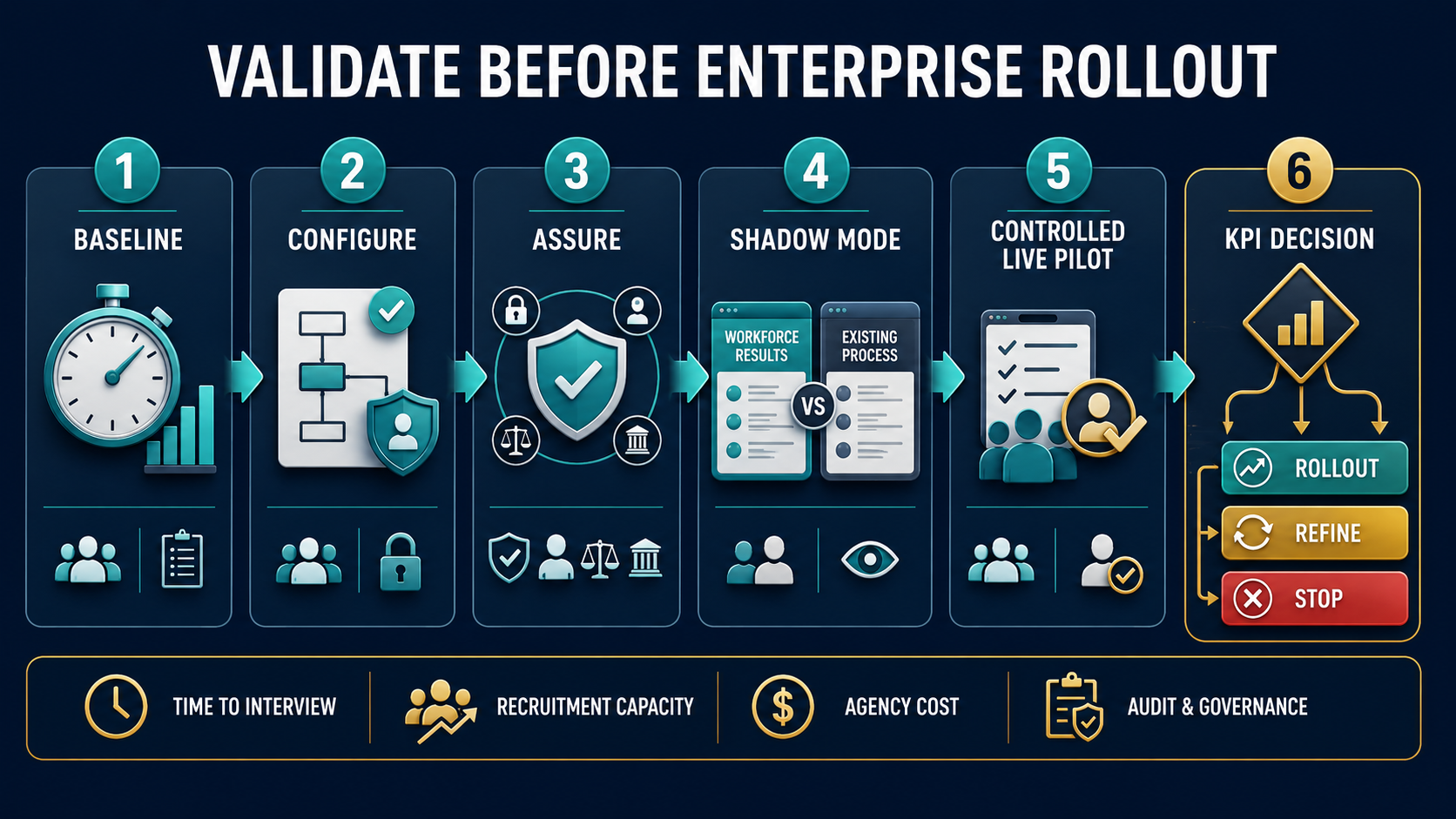
Workforce progresses from baseline measurement to controlled live operation, with rollout across the recruitment function approved only when the agreed operational, financial and governance KPIs have been validated.
Begin With a Controlled Baseline
Before implementation, the organisation and Strategic Intent would establish a verified baseline covering:
time from vacancy approval to interview;
recruitment administration time;
vacancies and candidates managed per team member;
vacancy duration;
agency expenditure associated with unfilled permanent roles;
candidate response and completion rates;
interview scheduling time;
candidate experience;
audit completeness.
These measures would become the agreed KPIs against which the pilot is evaluated.
Validate the Platform in Shadow Mode
Workforce could initially operate in shadow mode alongside the existing recruitment process. Its outputs would be assessed without allowing the platform to control candidate decisions.
This would enable the organisation to validate how effectively Workforce can:
generate draft job descriptions and competency questionnaires;
identify internal candidates and qualified candidate pipelines;
screen, score and rank applications against approved criteria;
identify right-to-work eligibility issues for human review;
automate recruitment-campaign administration;
manage candidate communications;
coordinate hiring-manager and panel interviews;
generate structured interview questions and evidence packs;
maintain a complete audit record;
identify capability gaps and development requirements.
Any material differences between Workforce and the existing process would be investigated before the platform progressed into controlled live operation.
Measure Performance in Live Operation
Once the agreed assurance and shadow-mode requirements had been satisfied, Workforce would manage a controlled group of live vacancies.
The pilot would evaluate whether the platform can:
reduce time to interview from weeks to a few days for suitable workflows;
increase the recruitment team’s processing capacity;
reduce manual administration;
shorten vacancy duration;
accelerate the replacement of long-term agency workers with permanent employees;
reduce avoidable agency and vacancy costs;
improve candidate communication and experience;
maintain consistent, evidence-based assessment;
provide a complete and exportable audit trail.
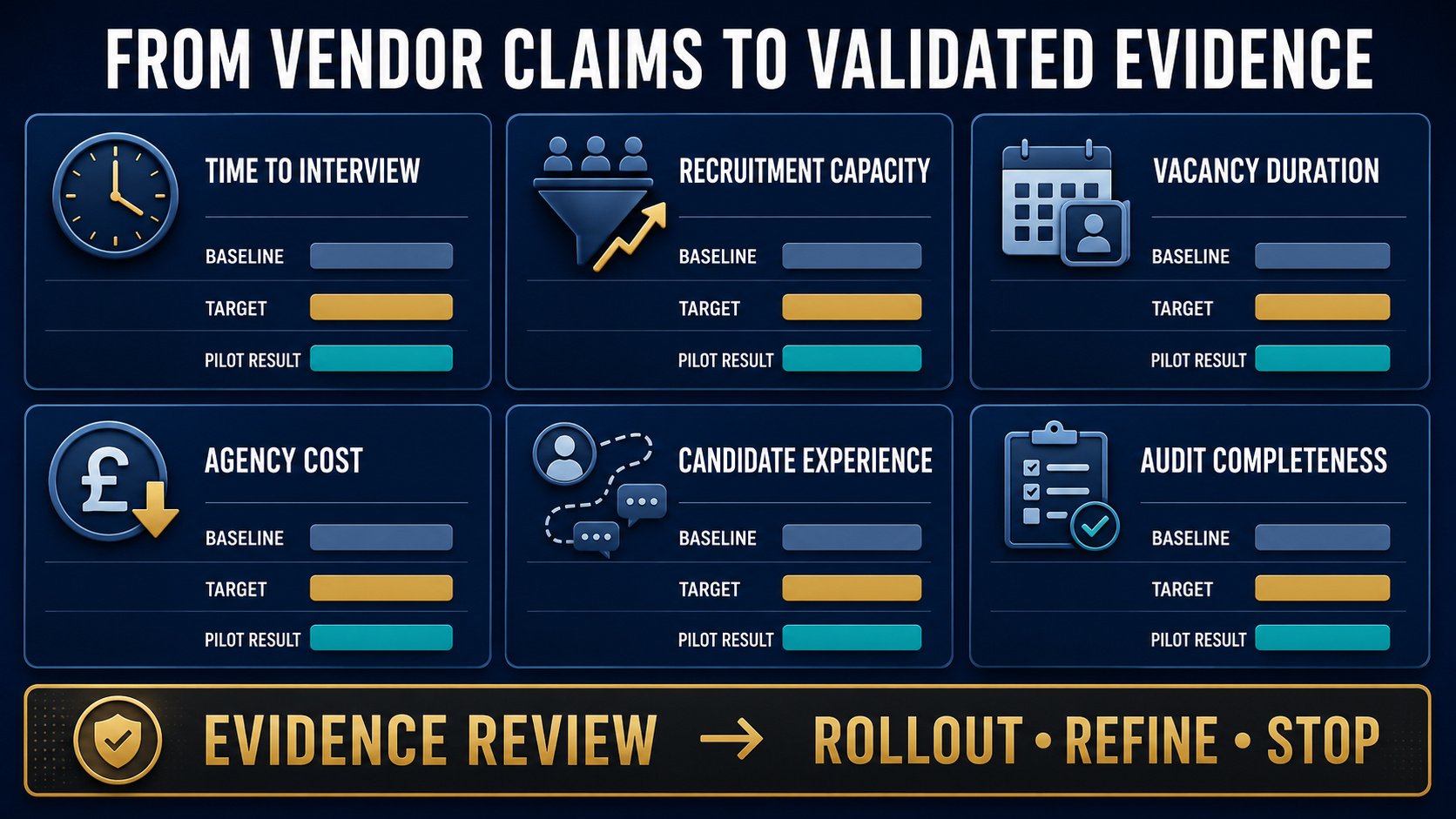
The rollout decision is based on agreed baseline measures and independently reviewable pilot evidence—not assumed benefits or unverified vendor claims.
An aspirational increase of up to tenfold in capacity could be tested for selected administrative processes. It would be treated as a KPI to validate, not as a guaranteed or previously established result.
In healthcare, the evaluation could also consider how faster permanent recruitment affects workforce continuity, service capacity and reliance on temporary cover. Any relationship with patient outcomes would require separate and appropriately governed evaluation.
Human Decisions and Full Governance
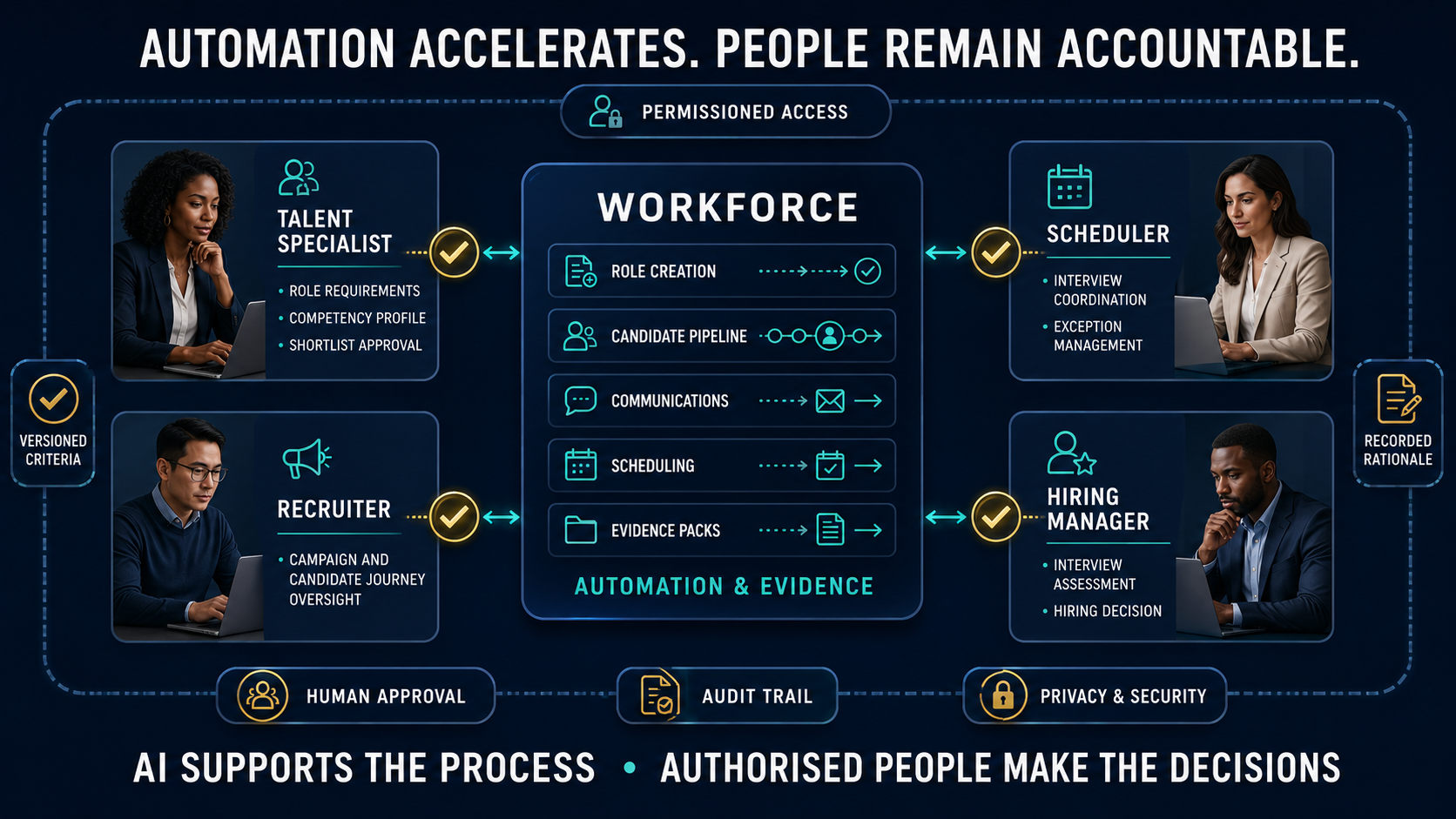
The validation pilot would retain human accountability at every material decision point.
Workforce would provide automation, evidence and recommendations, but authorised people would remain responsible for approving role requirements, shortlists, interviews and appointments.
The pilot would include:
permissioned and purpose-limited access;
separation of duties between operational roles;
approved and version-controlled assessment criteria;
human review of screening and shortlisting recommendations;
no silent automated candidate rejection;
recorded reasons for decisions and overrides;
transparent candidate communications;
security, privacy, fairness and accessibility testing;
data-retention, export and deletion controls;
defined escalation, rollback and exit arrangements.
An Evidence-Based Rollout Decision
The pilot would progress through controlled stages:
Scope and baseline agreement
Platform configuration and approved customisation
Security, privacy and governance assurance
Shadow-mode validation
Controlled live operation
KPI evaluation and enterprise-rollout decision
At the end of the pilot, the organisation would receive an evidence-based evaluation showing the KPIs achieved, any limitations identified, the validated financial opportunity and the requirements for wider deployment.
The organisation could then decide to stop, refine the platform or proceed with a phased enterprise rollout.
This removes the need to rely on vendor claims or an extensive previous track record. Workforce earns confidence by demonstrating measurable results inside the organisation’s own operating environment.
Validate Workforce Against Your Own Priorities
Select one high-volume or high-cost FTE recruitment challenge and establish whether Workforce can reduce time to interview, vacancy exposure and avoidable agency costs before committing to enterprise rollout.